


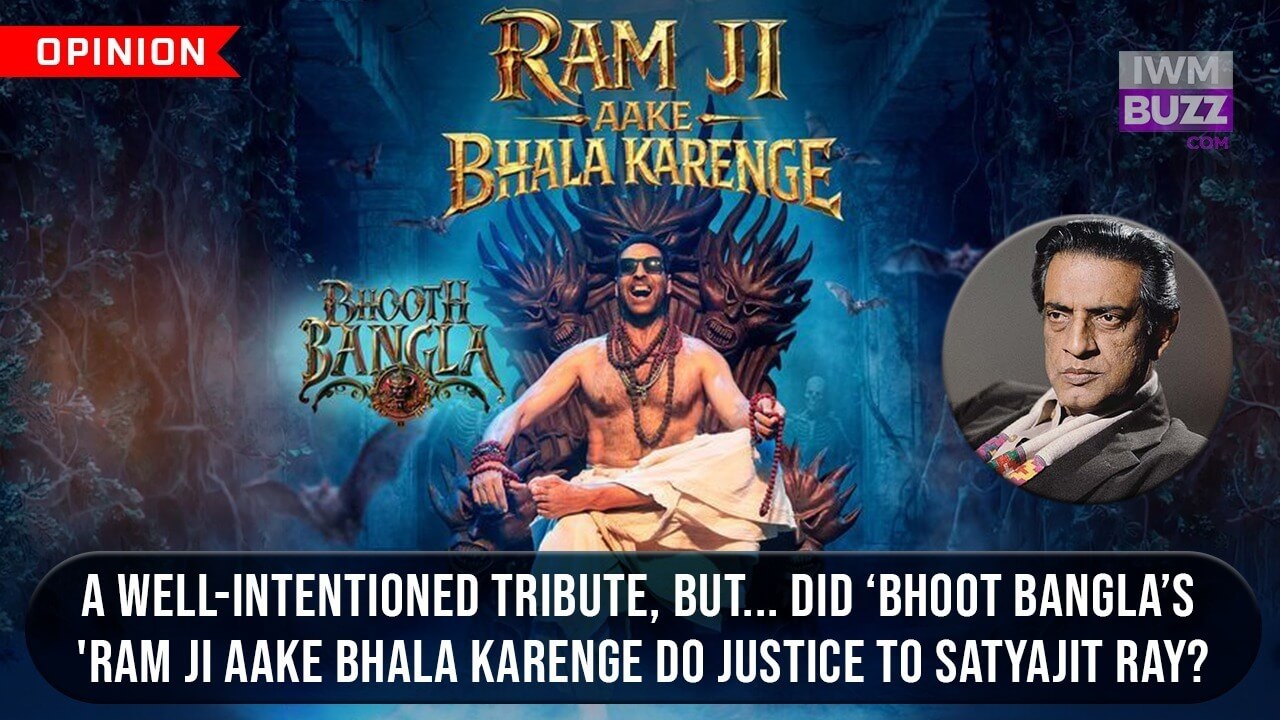
Bangalis often find themselves in a bamboozled quandary—whether to photocopy the footsteps of Satyajit Ray or not; however, we have let this debacle befall us, for Bangalis are their own best critics (sarcastically) at times, criticising each other every day for drowning ourselves in nostalgia. Satyajit Ray (May 2, 1921—April 23rd 1992) is an icon for Bangalis, a gem of the country, an Oscar winner—the Ray factor has always ignited joy. The quandary continues at every family gathering, where at least one guest brings up Satyajit Ray in conversation, and the pillow gets passed around—to discuss or not to discuss. Amid that, a peppy, fun song emerges with Akshay Kumar starrer ‘Bhoot Bangla,’—’Ram Ji Aake Bhala Karenge.’
The song has set the internet abuzz, igniting a spirited tug-of-war between nostalgia and originality. With Pritam at the helm, the track unabashedly tips its hat to Satyajit Ray’s 1969 cult marvel Goopy Gyne Bagha Byne, weaving in generous threads from the beloved Bengali anthem “Bhuter Raja Dilo Bor.” The music video tried to give a visual wink to the outlandish magic of Ray’s ‘fantasy’-comedy universe. There are fans who decry it as a “copy-paste” caper.
But let alone this social media fan war. We found some foundational backfires in the song, and the tribute to Satyajit Ray did not hit the right chords, therefore.
Satyajit Ray was an atheist
Satyajit Ray, an avowed atheist for much of his life, refrained from participating in Brahmo services and festivals during his adulthood. Satyajit Ray’s engagement with religious questions—particularly in films such as Devi (The Goddess), Mahapurush (The Holy Man), Ashani Sanket (Distant Thunder), Sadgati (Deliverance), and Ganashatru (A Public Enemy)—reflects the interplay of his Brahmo lineage, his personal atheism or agnosticism, and his deep cultural interest in Hinduism. In his cinematic representations of gender and caste, Ray’s perspective on Hinduism emerges as complex and non-sectarian; nevertheless, his films tend to foreground the religion’s adverse social repercussions—such as the perpetuation of gender inequality and caste oppression—while offering comparatively little emphasis on the constructive or affirmative roles Hinduism might play in Indian society and culture. “I was an atheist but I’m beginning to be more and more agnostic, as I grow older,” as Andrew Robinson quotes him firsthand in his piece ‘Enlightening Ray.’
In fact, after Devi’s release, the Oscar-winning director faced immense backlash, with critics claiming that he attacked Hinduism. In a 1989 interview with French journalist Pierre Andre Boutang, talking about it he said, “I once made a film called the goddess Devi, it dealt with religious dogmatism, it didn’t attack religion as such, it attacked dogmatism, the extreme form of religion…But people (are) writing in the papers that ‘Oh! Mr Ray is not a Hindu, he is making such films against Hinduism’. But they are stupid people you can’t take them into account. This happens in India all the time. We have a fairly backward audience here, in spite of the film society movement and all that, if you consider the audience at large, it is a backward audience.” He added, “An unsophisticated audience…and so you face this problem, but you make the kind of films (you want to) and I make the kind of films that I want to make. I make the kind of films that I enjoy making… that engages my attention, my creativity, that is all I can do.”
The tribute thus lands as a sardonic jest, ultimately rebounding with unintended irony. Laden with superstitious motifs and crowned by a title steeped in religious overtones, the song stands in stark contrast to Satyajit Ray’s perspectives.
Bhool Bhulaiyaa—A comparative lens
Comparisons flooded, with fans asserting the new film is the true sequel to Bhool Bhulaiyaa. The emotions Bhool Bhulaiyaa (2007) carries have been truly winning. Because there, Akshay Kumar’s “Dr. Aditya Shrivastav,” with wit and hilarity, who knows everybody is a ‘mareez,’ tells viewers of the country (that is already overshadowed with vicious superstition), not to believe in it, and gets us aware of ‘Mental Health,’ with humour. Aditya, ever the maverick, skillfully blends ancient rituals with sharp scientific reasoning to pull Avni Chaturvedi—aka Manjulika—out of her harrowing psychological Bhool Bhulaiyaa. Bhool Bhulaiyaa doesn’t just wave the flag for mental health and scientific inquiry; it also throws a vibrant, tongue-in-cheek party for Indian tradition along the way. The film is a wild, brainy romp where superstition and modernity dance together, leaving viewers both entertained and enlightened—in short, it’s just better.
The song ‘Hare Krishna Hare Ram’ we still play in a loop, in comparison to that, the above song was a bit of a turn-off for us, too; however, we are aware of the backlash the song brought back in 2007.
Bhooth Bangla is an upcoming Indian Hindi-language horror-comedy film scheduled for release on 10 April 2026.
