


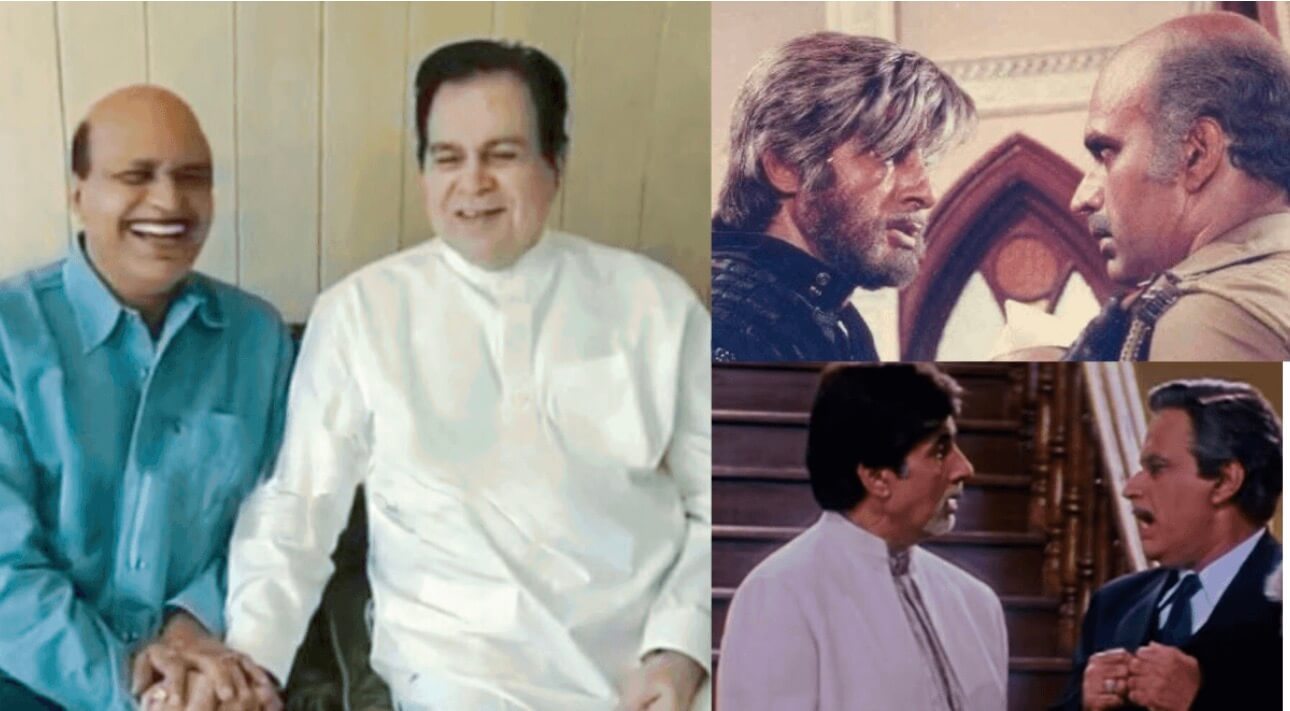
Raza Murad Sahab took me to RK Studios to meet Raj Kapoor Sahab while he was editing. He introduced me saying, “This boy wants to work with you.” Writer K.K. Singh was sitting nearby, so Raj Kapoor asked him which character was still uncast. K.K. Singh mentioned that while major roles were taken, there was a small two-to-three-scene role playing A.K. Hangal’s son near the beginning. Raj Sahab asked if I could do it, and I agreed.
The shooting took place at their Loni farm. Kulbhushan Kharbanda told me that I could stay at his house so I stayed there. I couldn’t sleep all night out of nervousness about working with Raj Sahab, as I was quite new to the industry. I woke up early around 6:00 AM, but Kulbhushan informed me that Raj Sahab’s shift started at 2:00 PM.
We shot the scene at the Boat Club, in which Raza Murad Sahab was giving a speech while I stood next to Kulbhushan. On his signal, I threw a slipper at Raza Murad, pulled out a knife, and rushed the stage before being apprehended by the police. It’s a staged plot to defame A.K. Hangal’s character.
I was nervous when I reached the set. On set, Raj Sahab warmly greeted me as “Avtar ji” and explained the shots. He was handsome man, a big director. I was a newcomer and nervous. During my close-up, Raj Sahab sat right beside the camera lens and told me to throw the slipper hard toward that angle. Afraid of hitting him, I threw it weakly. He corrected me, asking for genuine anger. When I threw it again with full force, the slipper grazed past his hair and ear. I panicked and ran off set, but he approved the shot and kindly praised the delivery. I shot for the film for three days.
That first night was one of three times in my career I lost sleep due to nervousness. The others being my initial shoots with Dilip Kumar and Amitabh Bachchan.
How was the film received, and what were the discussions around Mandakini and Rajiv Kapoor (Chimpu)?
The film became a massive blockbuster. However, people often discussed how, despite its success, Chimpu didn’t receive due credit or substantial work afterward, despite expectations of him becoming a star. As for Mandakini, Raj Kapoor’s films often generated censor debates.
When critics questioned the breastfeeding scene, Raj Sahab countered, “Haven’t you drunk your mother’s milk? It depends on the viewer’s perspective. What is wrong with a mother feeding her child?” He successfully persuaded the censor board.
Which film with Amitabh Bachchan kept you awake before shooting?
That was Shahenshah. In a key scene featuring Amitabh Bachchan, Amrish Puri, Prem Chopra, and Anjan Srivastav, I had the majority of the lines and had to scold Amitabh Bachchan’s character. The dialogue was written by Inder Raj Anand (Tinnu Anand’s father), and not a single word could be altered. I stayed up all night memorizing it.
On set, director Tinnu Anand even asked why I was smiling nervously. But the shot was okayed in only a couple of takes. But Amitabh-ji was an absolute professional. He stood like a newcomer, offered complete cooperation, and never asserted star power. I later worked with him across 11 to 12 films, including Baghban, Baabul, Hum Kisise Kum Nahin, Indrajeet, Mrityudaata, Major Saab, and Main Azaad Hoon.
How was your experience working with Dilip Kumar?
I worked with Dilip Sahab in three films: Aag Ka Darya (unreleased), Mazdoor, and Yash Chopra’s Mashaal. On my first day for Mashaal, I had four lines while he had one, and I had lied about knowing how to drive a Mercedes just to secure the role! Sensing my anxiety on set, Dilip Sahab discreetly told Yash Chopra in Punjabi that he needed a couple of rehearsals.
He put his arm around my shoulder, walked me around the location, rehearsed my lines, we chatted in Punjabi, and put me at complete ease before telling the director he was ready. He’s my favourite actor and I consider him as the biggest actor in India.
Later, during Qila, we became close friends. After dinner, we would walk for hours, conversing in Punjabi about sports, life, and our shared alma mater, Khalsa College in Mumbai, where he studied in the 1942 batch and I graduated in 1974. He possessed an incredible aura, yet remained remarkably humble and soft-spoken.
