


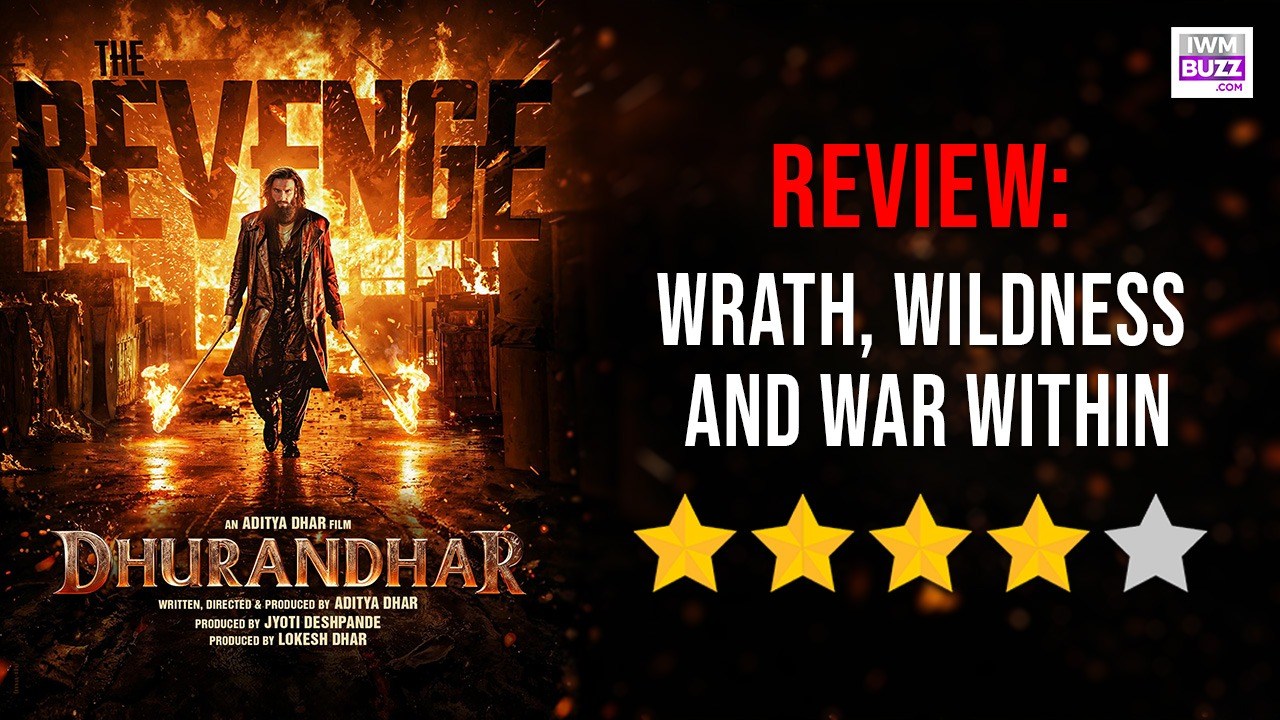
Politically inflicted communal tensions confront you as you see the story of a spy, Hamza Ali Mazari (Ranveer Singh) unfolding—it begins with the bygone memories (A burnt memory), where a young Punjabi boy (Jaskirat) finds his first inducement to go on a killing spree for his sister—followed by a death sentence—and that’s where the tale of vengeance begins—driven by wrathful wild will to give retorts to communal infliction. IB Chief Ajay Sanyal (R. Madhavan) pulls him up for Project Dhurandhar.
Emotions run wild, between two nations—eventually taking the shape of “Wrath Of God”—Dhurandhar is lethal, just as Major Iqbal (Arjun Rampal)—the ogre in Hamza is volatile and hostile, as we see it in the young boy Jaskirat. It’s his volition to give justice, initially to his sister and then to his country. Ranveer Singh gives away no chance to look away. Hamza, aka Jaskirat, keeps his emotions in check, has a heart that loves—yet his idiosyncratic fate erases his past and sets him on another chapter. By the end, you begin to empathise with the life of a spy—nothing really remains his own—nothing really he can hold onto—no home to return to, and no pain to feel either.
Arjun Rampal as Major Iqbal is a visual feast—he prowls across the screen with feral emotions barely caged, his rage and vulnerability leaking through every glare. You soon discover this wildness is not mere performance: its roots burrow into childhood—his father’s relentless rebukes forging him into a creature of both fury and longing. And yet, for all his smouldering presence, Rampal’s range remains an untamed expanse, glimpsed but not fully explored—much like Sanjay Dutt’s steely SP Chaudhary Aslam and R. Madhavan’s enigmatic Ajay Sanyal.
The second half is Hamza’s playground of chaos—he’s handed the keys to his own carnage carnival, turning every frame into a riot of blasts, bullets, and bravado. As bodies drop and mayhem crescendos, Hamza unleashes to the beats of Khaled and Tamma Tamma.
The film’s fever-dream of politically charged communal strife is a wild siren call to our collective conscience, daring us to interrogate the fault lines within ourselves. Each explosion of violence, every scar etched in the name of any tribe or any nation, ricochets off the screen and into our own tangled histories, demanding that we confront the seductive pull of vengeance and the radical, rebellious act of choosing empathy instead. The chaos isn’t just out there—it’s in here, thrumming beneath our skin, insisting that saying no to such communal hatred is an act of ferocious, untamed courage.
And yet—through all this riot of emotion and meaning—you find yourself spellbound by the director’s audacious craft, the grand spectacle of the screenplay, the almost animal intensity of the performances. The actors bare their teeth and soul, prowling the screen with a kinetic, unpredictable energy that’s impossible to resist. When the credits roll, it’s not just the message that lingers, but the wild, electric pulse of cinema at its most alive—a film that claws at your conscience even as it dazzles your senses.
The ‘Wrath of God’ is against hatred. Not against humans or humanity.
IWMBuzz rates it 4/5 stars.
