


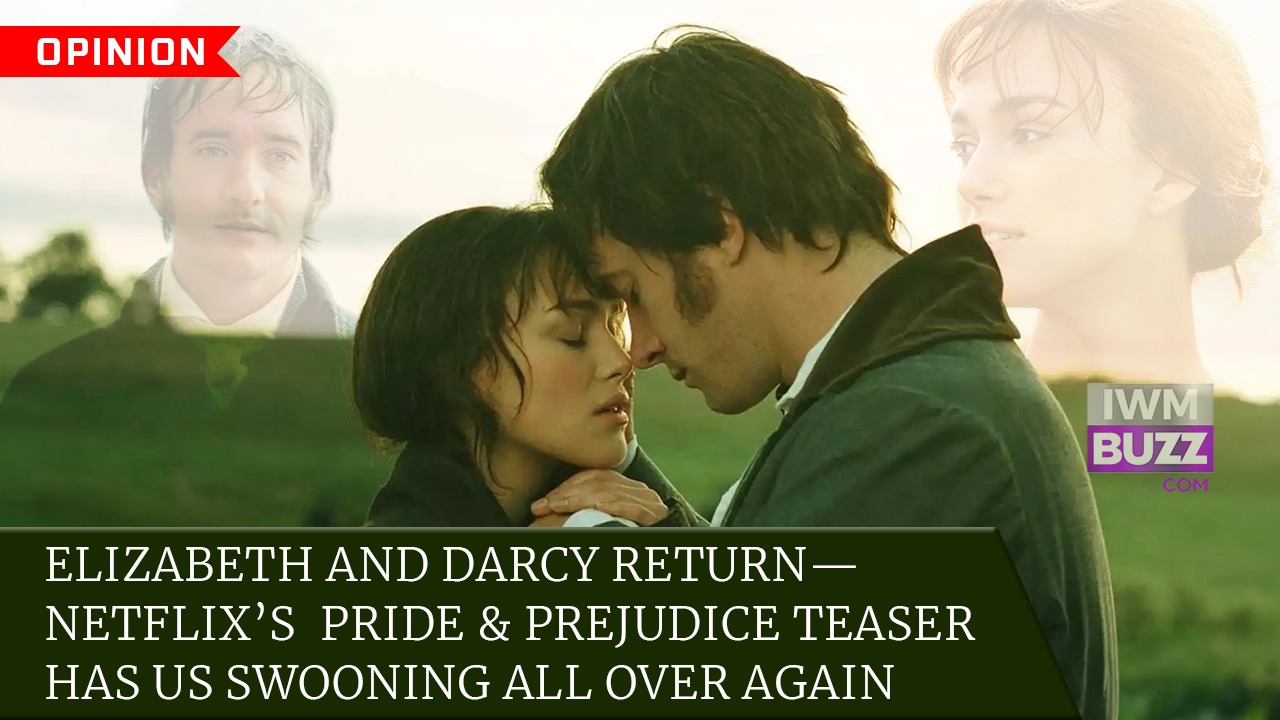
Jane Austen’s Pride & Prejudice empowers us—it offers witty lessons on society, class, and love. Countless adaptations, and it is the only time we can say ‘more is less’, well, guilt-free. And with all the love reverberations that we are all currently occupied with, Netflix just got us all swooning once again, with its adaptation of the classic, and making the forever, delicious couple return—Elizabeth and Darcy. The 2005 film adaptation of Pride & Prejudice continues to hold its crown, much as the beloved novel itself does. Now, we’re invited to experience its magic anew, as if for the first time—vivid and fresh, yet steeped in the romance that has enchanted us for decades.
The teaser trailer just teased us for good, revealing not too much, but giving you a feel for the Georgian period in Britain—the ambience it holds, the costumes, the glances, the encounters, the simmering tension and romantic entanglements the series has to offer. We get our first tantalising glimpses of Corrin as Lizzy and Lowden as Darcy. The cast includes Rufus Sewell as Mr Bennet, Louis Partridge as Mr George Wickham, and Fiona Shaw (Killing Eve) as Darcy’s aunt, Lady Catherine de Bourgh, among others.
Returning to the novel, Austen satirises the idea of marriage. She comments on the societal drawbacks of the times back then, which are reflected in the courtships we read about. Her protagonist, Elizabeth Bennet, builds the crux, who goes against the conventional idea of marriage back in those times, which is that marriage should occur on the basis of love, nothing more, nothing less. Elizabeth stands out as the woman who seeks a partner based on genuine affection rather than fortune, setting her apart from her mother and sisters, who are willing to marry men they do not love for the sake of security and social advancement. Therefore, her character doesn’t fit the generalisations—while she commits blunders, driven by her pride and prejudices, she stands firm in her sexual equality with Darcy. The novel was initially named ‘First Impressions,’ something that navigates the courtship of Darcy and Elizabeth. While their marriage remains the most successful in the story, what chills us is how their relationship unfolds within the social hierarchies. Darcy falls in love, steps back for his pride, but his longing and yearning for Elizabeth continue; however, Elizabeth rejects it, well, again, for her pride. Austen affirms in the pathway that their union can only be through love, not through any other means.
As we re-read the novel, we find uncanny similarities that we have even today. Jane Austen deftly employs irony throughout the novel to expose how deeply society is shaped by considerations of social rank and wealth, and how marriage is upheld as the ultimate goal for women. By satirising the idea of marriage within a materially driven society, Austen reveals that unions founded solely on personal attraction, financial gain, or social standing inevitably lead to misery, shame, unhappiness, and isolation. Therefore, love should remain the untimely stem of any marriage that takes place.
