


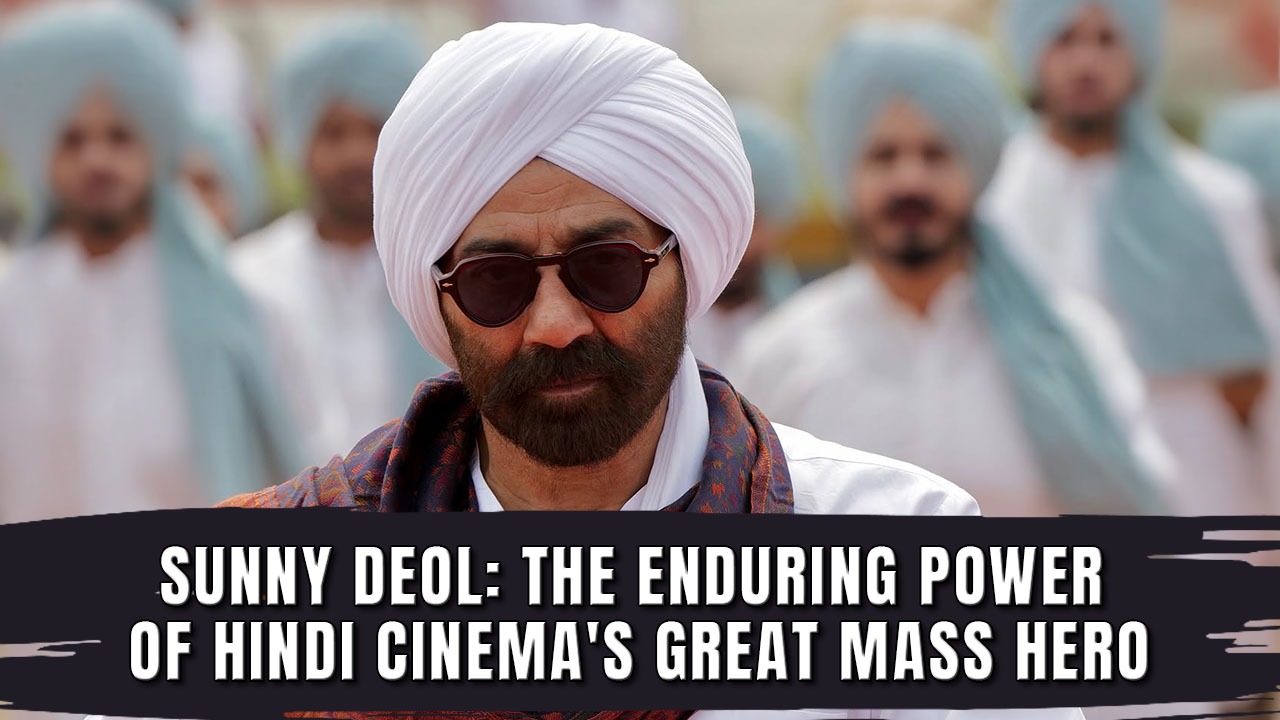
Hindi cinema has witnessed countless stars rise, reinvent themselves and, eventually, fade with changing tastes. Few, however, have sustained a bond with audiences as instinctive and enduring as Sunny Deol. In an age where celebrity is often built through constant visibility and meticulous image management, his stardom continues to rest on something far rarer: emotional credibility.
Right from his debut in Betaab (1983), Sunny has charted a path unlike that of most mainstream stars. He began as a sensitive romantic lead before gradually evolving into Hindi cinema’s definitive embodiment of righteous anger. Yet even as his films embraced larger-than-life action, the emotional core of his characters never disappeared.
His heroes were not fearless supermen, they were ordinary individuals pushed to extraordinary limits by betrayal, injustice and institutional failure.
That identity became the foundation of Sunny’s greatest performances. Arjun (1985) introduced a restless young man confronting corruption, while Tridev (1989) strengthened his image as an action star with substance. The 1990s, however, cemented his legacy. In Ghayal (1990), Damini (1993) and Ghatak (1996), he portrayed men whose violence emerged not from arrogance but from desperation. His characters fought only after every lawful and moral avenue had collapsed, giving his action sequences an emotional weight rarely matched in commercial cinema.
The actor’s performance in Damini remains one of the finest examples of commanding impact despite limited screen time. Winning the National Film Award for Best Supporting Actor, he transformed a courtroom drama through sheer conviction, delivering dialogues that have become an enduring part of popular culture.
If the 1990s established his craft, Border (1997) and Gadar: Ek Prem Katha (2001) elevated him into a pop culture legend. These films were more than commercial successes, they became defining moments in the history of patriotic Hindi cinema. Rather than depending on pure visual grandiosity, his characters resonated by weaving love of country together with sacrifice and familial integrity, making patriotism feel intensely personal.
N.R. Pachisia, producer of Sunny’s films such as Arjun Pandit and Ziddi, said, “My perspective comes down to one key thing about him: he has that innate mass-hero build. He is a quintessential action hero, and he holds his facial expressions extremely well. That’s what sets him apart from others. He carries a larger-than-life persona. Personally, I also feel he is a very good actor.”
He adds, “I think people love the way he performs and delivers his dialogues. He’s loud, powerful, and aggressive. If you look at all his movies, right from when he became immensely popular with Ghayal, Ziddi, Farz, Arjun Pandit, then Border, Border 2, and Gadar and Gadar 2. Gadar was his ultimate benchmark, according to me”.
Although Actors his age usually transition into character roles, Sunny Deol continues to play the lead. Pachisia said, “He stays true to character as well. What happened with Sunny Deol isn’t possible for just anyone. He’s already 69! I mean, delivering Gadar 2, then Border 2. In between, he had Jaat, which was reasonably fine, not bad. But at an age when actors typically become character actors, he is playing the main lead. And not just any main lead, but an extraordinarily powerful, heavy-built main lead. On top of that, he’s delivering ₹500-crore hits! Delivering ₹500-crore and ₹300-crore blockbusters. So it’s truly commendable. In my view, he remains authentic to his craft and fearless. “Fearless” is the right word for him.”
Pachisia further added, “Right from his early days, if you look at films like Arjun, Arjun Pandit, Ziddi, Border, Gadar, or Jeet, his filmography is quite amazing. He did Indian, and then he went through a lull period for a very long time. But everyone goes through that. He was fortunate because when Gadar was re-released in theaters, that’s when everyone realized, “Man, Gadar 2 is going to be a huge hit!” People went back to watch Gadar, which had fantastic music, and then you know the massive opening Gadar 2 got.”
What has always separated the macho actor from other action stars is not physical power, but emotional conviction. The famous dialogues, the explosive confrontations and even the most exaggerated action sequences work because the audience believes the pain behind those dialogues and punches. His performances communicate outrage born of injustice rather than invincibility, making even his most iconic cinematic moments feel emotionally earned.
Equally compelling is the contrast between the man and the star. Away from the screen, Sunny Deol has long maintained a quiet, private and understated personality. On screen, he becomes one of Hindi cinema’s most commanding presences, a transformation that has only strengthened his mystique over the decades.
His career has also demonstrated unusual resilience. Like every major star, he experienced periods of declining commercial fortunes. The mid-2000s and much of the following decade saw several films underperform at the box-office, but he resisted the temptation to radically reinvent himself or chase fleeting trends. Instead, he remained faithful to the screen persona that audiences had embraced for decades.
During this phase, he also explored filmmaking when he had to step in as a director after a creative fallout with the original, British director Gurinder Chadha over the project, London (1997). The project was recrafted as Dillagi (1999), marking the actor’s directorial debut of a deeply personal drama starring himself, his brother Bobby Deol and Urmila Matondkar. Though the film did not achieve major commercial success, it revealed a more restrained, introspective creative side that contrasted sharply with his on-screen image.
Beyond cinema, Sunny entered public life when he contested the 2019 Lok Sabha elections from Punjab’s Gurdaspur constituency on a Bharatiya Janata Party (BJP) ticket. His victory marked a new chapter, even as he largely maintained the same low-profile, understated public persona that had defined him throughout his film career.
Yet rather than relying on constant reinvention, he remained faithful to the qualities that defined him from the beginning. That patience was rewarded when Gadar 2 emerged as one of the biggest blockbusters of its time, proving that genuine audience affection can survive changing trends and generations.
Taran Adarsh reasons the longevity of the actor. He said, “If you look at his body of work, he has made a lot of mass-oriented films. People across metros and beyond love him. Having such a fan base in the mass circuits is a rarity. It’s very tough. And Sunny Deol has cultivated that over four decades, right from his very first film, like his father Dharmendra. He also had solid pull in mass circuits. Look at his recent releases like Gadar 2, Border 2, Jaat and the upcoming Batwara 1947.”
He adds, “But even if you look at his earlier films, masses have always gone in for his films, and that is why the strong fan base has been built over decades, and it’s still intact. More than majority of his films are mass-oriented films.”
Sunny Deol continues to play the lead even today. Taran Adarsh said, “In Hindi cinema, we want to see a hero and he fits into that description very well. When he says, “Dhai kilo ka haath” or pulls out a handpump, people believe it! Other actors won’t be able to pull that off. Sunny Deol’s personality has that power. He has that aura,” Adarsh further added.
Perhaps the greatest measure of Sunny’s legacy is that he never attempted to imitate global action heroes or reshape himself according to industry fashions. His cinema has always remained rooted in the emotional landscape of the Indian heartland, where honour matters, family defines identity and justice is worth fighting for. This was seen even in his most recent film, Ikka on OTT. That unwavering authenticity has made him not merely a successful actor but a symbol of a particular tradition of Hindi film heroism.
More than four decades after his debut, the actor continues to headline major productions while many of his contemporaries have moved into character roles. At 68, he remains one of the few actors capable of carrying a large-scale commercial film on the strength of his persona alone.
Senior journalist Dilip Thakur said, “Sunny Deol remains a leading man and a true mass hero even today because he has carefully protected his image over the years. His career began with Betaab in 1983, but the real turning point came when he started working with directors like Rajkumar Santoshi, whose fresh vision helped redefine him as a powerful action star. I remember an incident from the shooting of Narsimha in Nashik. During a casual conversation, Sunny told me, ‘Whenever I reach a film set on the first day, I observe the director. If an actor starts telling the director where to place the camera or how to shoot a scene, and the director simply follows those suggestions, it means he lacks conviction. A director must have complete command over his vision.’ That reflects Sunny’s deep understanding of filmmaking and why he always valued strong directors.”
He adds, “After Gadar, he became extremely selective about his films. He never overexposed himself, maintained his fitness, stayed away from controversies, and preserved the larger-than-life image audiences associate with him. The goodwill earned by his father, Dharmendra, certainly helped, but Sunny sustained that legacy through his own choices. While many of his contemporaries moved into character roles, Sunny continued to command the screen as a leading hero. Above all, his action feels real. It has weight, intensity, and authenticity. It never looks artificial or manufactured. That’s why audiences still see Sunny Deol as one of Hindi cinema’s last genuine mass heroes.”
As anticipation builds for Batwara 1947 and Ramayana where he plays Lord Hanuman, Sunny’s remarkable journey serves as a reminder that true stardom cannot be manufactured. It is earned through performances that audiences believe, characters they remember and an emotional connection that endures long after cinematic trends have changed.
Keep reading IWMBuzz.com.
