


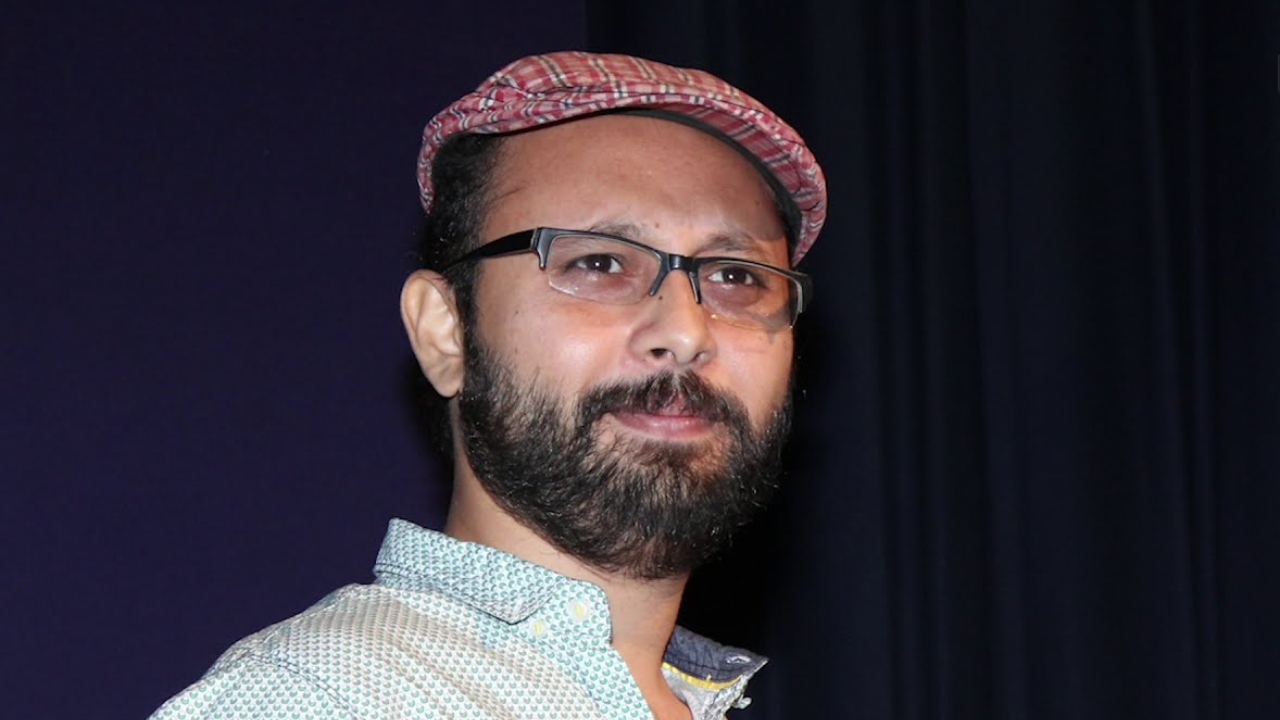
From clearing the prestigious AFMC entrance exam and walking away from a secure medical career to co-writing Chintu Ka Birthday, penning the poems of Udaan, and creating the acclaimed Netflix series Black Warrant, Singh’s journey has been anything but conventional. Across writing, directing, and teaching, he has built a reputation for treating screenwriting as both an art and an academic discipline.
In this candid conversation, Singh reflects on taking the leap from medicine to filmmaking, the collaborative process behind Black Warrant, the evolving role of the showrunner in India, the challenges of writing for streaming platforms, censorship, AI’s growing influence on storytelling, and why young writers should think in decades rather than chasing overnight success.
You switched from medicine to writing. What gave you the conviction to take that risk, and how did that urgency shape your early work ethic?
Actually, I wanted to become a filmmaker around the same time I decided to become a doctor, which was in school when I was in class 8 or 9. I saw both dreams at the same time. Coming from a small town in Bihar, the road to reach a medical college was relatively easier, and I knew what to do to get there. It required a lot of hard work, but thankfully, in the first attempt, I cleared AFMC, Pune, which is one of the most prestigious medical colleges. I had a good time there. It’s an amazing institution and spending five years there was a highlight of my life.
At AFMC, extracurricular activities are encouraged as it’s run by the armed forces. I did a lot of poetry writing there. In fact the first poem in Udaan, Joote kahan utaare the, was written when I was in AFMC, and when our batch was passing out. I had written that about me, but it became a part of Udaan. We used to make short films there. My brother Devanshu was studying Mass Media in Mumbai, so we used to visit each other in either Mumbai or Pune. So, in a way, AFMC was my film school. I was the secretary of the music club there. We used to perform music on stage and in other colleges. So, that was the culture.
But two things happened. My brother found a way and became an assistant director with Nikkhil Advani on Chandni Chowk to China (2009). I had written three feature film screenplays while doing MBBS. I wrote my first feature film at the age of 22 and then wrote another at the age of 23 during the final year of college. My brother and I co-wrote Chintu Ka Birthday (2019).
So, by the time my MBBS was done, the first couple of drafts of Chintu Ka Birthday were ready. They were being received very well by the industry. Because of those two breakthroughs, it was relatively easier for us to decide to take that risk immediately. A bigger part of that risk was that the armed forces required me to join the armed forces as a medical officer. And if I didn’t want to do that, I had to pay 15 lakhs of rupees (this is 18 years ago) to the government of India to quit my job.
We didn’t have any money, so about 25 friends from school and college, some of Devanshu’s friends like Tanmay Bhatt, contributed and helped me raise that money, and that’s how I started my life. Because of all this, it felt like an easy decision. It didn’t feel like a difficult decision. It almost felt like a fairytale.
There was urgency because of financial pressure, as I had to pay back the money I had taken from my friends. But I never took an easy way out for money. We did what we wanted to do. So, after moving to Mumbai, I kept studying cinema and writing feature film screenplays one after another. That quickly started opening doors because some of my early screenplays were strong enough to be noticed.
I think more than anything, because of the academic background since childhood and then MBBS, I took cinema as an academic field, and I’m still a dedicated student of cinema. I think that’s a very special work ethic that I have. That formed very early, and I’ve been following it.
From writing poems in Vikramaditya Motwane’s debut Udaan to writing & directing your biggest show Black Warrant, where Motwane served as a Showrunner, does it feel like a full circle? Do you feel like you’ve arrived?
This is a special journey because my first project was writing the poems for Udaan, and my first big project that really put me in the spotlight is Black Warrant again with him. So, it does feel like a very special journey. Of course, it feels like I’ve arrived, but in a different sense. Since I cleared the AFMC entrance as a teenager, I’ve always felt that I’m capable of doing a lot, and I’ve also accomplished a lot. I really don’t chase this kind of a validation that finally people can see that I’m good. Of course, it feels good, but that doesn’t drive me.
Since I teach as well and I have my ecosystem, if I grow in power, a lot of people will benefit. So, that way I feel I’ve arrived. People take me seriously. If I introduce a young writer to someone, they take that writer seriously. And that’s a blessing. I think one big change that has happened is that, you know, when you haven’t achieved big success, even if you don’t question your ability, you limit your dreams. This definitely happens. When you haven’t achieved anything you feel like you get into a writer’s room and that becomes your dream. But when you achieve something, you can dream bigger.
So, I think that’s what Black Warrant has done. I’ve started thinking about a big screen theatrical film. It’s giving me the right kind of push and energy to dream bigger, and that’s empowering because we don’t doubt our abilities, but if we dream small, then we can achieve only small things. I never thought that my dreams were limited. After Black Warrant’s success people are asking me what I’m doing next. Then I realized that has definitely changed.
While adapting a show like Black Warrant, where do you draw the line between creative liberty and moral responsibility toward real history?
I think changing history is a no-no. You cannot change the time and date of a historical event such as Indira Gandhi’s assassination. But if a another case that doesn’t affect the context of our story’s narrative, especially if we’re not assigning a date to it, then we can take that much creative liberty.
Factual correctness is very small part of history. The big part of history is the morality of it, the perspective: whose story are you telling? I think that’s where I’m very proud of our perspective. For example, our take on capital punishment, our take on the Indira Gandhi regime before the assassination, and the anti-sikh violence that took place after the assassination. I think our conscience is clean about those things. Vikramaditya Motwane, Arkesh Ajay and I have kept these things correct.
In fact, when we felt like we were over-sympathizing with a certain personality or section, we used to check that we can’t be that sympathetic. It can’t be that personal. It has to have a certain kind of maturity to it. I don’t think we ever reached a point where we were in conflict about whether doing something was morally correct or not. Our morality and politics was easy to align. Our creative liberties never crossed a line.
According to you what made Black Warrant stand out?
Frankly, we weren’t expecting the kind of love Black Warrant got. We made the show we wanted to make. I was curious to know the audience reaction, but I didn’t expect it to be this positive. I think Black Warrant stood out because the collaborative energies were really in place. Black Warrant is a show which, in many ways, I wouldn’t have written, and Vikram sir wouldn’t have made. I did certain things because he wanted it and he did certain things because I wanted it. I think the show became an interesting mixture of our sensibilities.
After that Arkesh understood it and wrote it further. We’re childhood friends so that also made it easy. Applause Entertainment (producers) played an important role before Netflix came on board. Applause protected us creatively. We could make whatever we wanted to make because of Applause. The production level difficulties are there in every project and we did our best. But overall, the protection that Applause gave us played a big role in what Black Warrant became.
The show worked for the audience not only because of the writing, but also because of the background score, performances, camera work, edit, sound design and every department shined in their work. The collaborative energy was so good, and of course it was because of Vikram Motwane. If we have to remove all of this and look at what the audience is saying, then I’d say that Black Warrant is a fresh, tastefully done show.
I think the audiences were surprised by the tonal choices. The world was used interestingly. I feel the writing was unpredictable. Every episode was unpredictable. So many reviews have written that it was difficult to understand what the writers were aiming at. Of course, it was very intentional. It was risky too to do that kind of writing. But we wanted each day in Tihar to look like a different day. I think those unpredictable tonal choices made it an attractive preposition.
Where do you think Indian OTT shows still struggle most when it comes to mid-season pacing and episode endings?
The mid-season pacing struggle is real. Most of it lies in the writing. These problems will be solved if writing gets the time it requires, the respect it deserves, the feedback it needs, not just praise but constructive criticism. The showrunners, producers and directors should ask writers the right kind of questions so that they are forced to find answers. It’s rare to find such nurturing environment. Vikram Motwane enabled that kind of environment.
I’m that kind of a person who would rather put six months of extra work than allow mediocre work to go out. It is painful and money wise it makes no sense. There’s hardly any money. If you divide writing fees into 3-4 years, you’re left with nothing. So, as long as the how of development is not solved, these problems will keep arising.
The term Showrunner is widely used in the West, but in India, the boundary between director, creator, and executive producer can be blurry. What does genuine creative ownership look like for an Indian showrunner today?
Our industry is still figuring out what exactly is Showrunning. Vikram sir also said that he understood what Showrunning really is after doing Black Warrant. We had five directors on the show, including Vikram sir and me, to direct seven episodes. When there are these many directors, the creative leadership and accountability lies with the showrunner.
It was Vikram sir’s idea to work with multiple directors. And I love that idea because the more opportunities we give to new people, the bigger projects they’ll get to work on. It’s also very challenging for a team of five directors. Shakun Batra asked me whether I’d ever like to be a showrunner and have five directors directing the show. I said, absolutely yes. We have done it once. If we do it again, we’ll be able to master Showrunning.
I think this question will be valid if a person is interested in becoming a showrunner. Like it’s a career ambition for them or if they find themselves in the situation where they have to become a showrunner. Right now, direction and showrunning are so overlapped that the question is not very relevant. We don’t have 30-40 showrunners who want to genuinely do Showrunning.
I think Showrunning is a good career option for senior writers or the writers who are getting established. So, the confusion will remain as long as Showrunning doesn’t become a culture. It’ll be a lot of fun if it becomes a culture. Like the creative onus of a feature film lies with the director, the creative onus of a series should lie with the showrunner. Once that onus is established, the roles and responsibilities of a director will be figured out.
How has the shift in platform algorithms and viewer retention metrics affected the way writers rooms approach character development? Are platforms asking writers to sacrifice slow-burn storytelling for quick hooks?
The impact of algorithms is there, and the platforms are telling writers what to do and what not to do. But I don’t necessarily see it as a wrong thing. Maybe you shouldn’t make decisions based only on algorithms. But if there’s wisdom in algorithms, then you shouldn’t dismiss it either. I think writers must be approaching it in two ways. One, if algorithm-based writing is being asked of them, then they’re doing it. Two, writers might challenge why they’re being asked to do so. I can understand both approaches. Both have their compulsions. I’m not judging either of them.
I think there’s a third option that writers can choose. It’s the most difficult option but I think like many difficult paths are the right paths, the third option is like that. The third option is that you listen to what the platforms are saying about algorithm bit don’t do what they’re telling you to do. You come up with something that you also like, and it fits into the algorithm wisdom too.
Don’t fight over the first two options. Bring the third one that both parties can embrace. It’s very difficult but as long as we manage to do it, we can bypass the algorithm question. Also, the relationship between executives and creatives will remain healthy.
Unfortunately, the complete onus comes on the writer, but he doesn’t get the money, perks, or credit he deserves for doing an impossible job. The ecosystem needs to look after the writers, but the writers should have the attitude that they will find solutions that’ll be a win-win for all.
Over the past few years, Indian streaming platforms have faced increasing regulatory scrutiny and legal sensitivity. How significantly does self-censorship play out inside a writers’ room during early ideation?
Censorship is a big reality. The usual tendency is that of self-censorship. Of course, it’s a serious and sensitive matter legally because it’s difficult to say what you want to say. The answer is not to question it. I think we don’t need to do self-censorship. We need to take the studios in confidence. We need to educate them and then mutually come to a decision to find a way to do what we want to do.
But I don’t think writers need to do self-censorship at least in the first draft. You must write what you want to say. It’s necessary for our character and self-respect. Censorship is a tricky thing and can’t be solved easily. Unless you have support from the producers and studios, you won’t be able to solve it.
Having read many scripts through film schools, workshops, and development labs, what is the single most common structural flaw you see in Indian screenplays today?
I think the most common structural flaw is that screenplays are thin. Screenplays have width, but they hardly have depth. It’s a structural flaw because a screenplay is an extremely economical medium of telling a story. You do not have the number of pages that a novelist has. In about 90-120 pages, you’re expected to write a dense, rich masterpiece.
Now, that density is missing because each page and each scene should serve as many functions as possible. For example, if a scene is introducing a protagonist, its function cannot only be the introduction of the protagonist. There are various functions of a scene, and most of the scenes that we write have one or two functions.
As a result, our screenplays tend to be longer as we need more scenes to achieve the same degree of richness or information, and the scenes are not as rich and dense as they should be.
For example, the introduction scene of Bhuvan (Aamir Khan) in Lagaan (2001). That scene introduces Bhuvan, the protagonist, and Captain Russell, the antagonist, and it has a big narrative role. Basically, Bhuvan and Captain Russell meet each other for the first time and Captain Russell remembers it and that’s why when he gives the cricket challenge he mentions, “Tum hee the na jungle mein? Tum jaanwaron ke rakshak ho?”
That’s a dramatic scene. It has emotional power; it’s thrilling, you feel angry for the British, and that scene also has an insight into the world, so it has a sociological aspect too. Introduction to the world, and the manners and the game of that world. Apart from this, in a nutshell, that scene is the microcosm of the film because Bhuvan is playing a game of distracting the deer, and the British are playing a game driven by their cruel sense of pleasure. It’s a game going on between Bhuvan and the British, which is Lagaan.
Now, it’s a long scene. But it’s not a long and thin scene. It’s a long and dense scene. And that’s why, when that scene is over, you witness a miracle: such dense writing can be achieved only if you commit to not really trimming down the scene, but making it dense. I think overall we tend to write long screenplays because we want to do a lot of things. And then we tend to trim it down because it’s long. As a result, we never work on the depth, richness, or density.
All of this is structural because you can use ten scenes to achieve one function each, or you can use one scene to achieve ten functions, and it’s a structural choice. So, I’d say this is the most common structural flaw: our writing is not rich and dense enough. It’s mostly wide and superficial.
Indian cinema has a rich tradition of strong dialogue, but often falls short on subtext and active visual storytelling. How can young writers learn to write scenes where what is not said carries the real weight?
I think the recipe for subtext-rich dialogue or good dialogue is character work. I think what people don’t understand is that dialogue work is actually character work. If you want to improve the dialogue of your film, then instead of focusing on the speech, focus on the character. Build the character with greater understanding and richness.
In fact, what I do is apart from building the physical, psychological and sociological self of the character I also figure out its speech. There can be a dedicated method used to figure out the speech because you want to break it down into its different stylistic components. So, character work is weak, and that’s why dialogue is weak.
The second thing is pretty much the same as the screenplay. Each dialogue must have more than one function. If your dialogue has only one function, it sounds contrived, serving the writer’s intention. If the dialogue has more than one function, then the audience cannot see the writer’s intention because a lot is going on, so it’s difficult to see the writer’s intention. So, if dialogue is economical, not just short, but it should try to achieve as much function as possible. Then it will become rich.
For example, dialogue that takes the story forward can also evoke emotion, reveal character, use great wordplay, and offer the pleasure of language. If you pay attention to these possibilities- how many functions each line of dialogue can have and if you painstakingly bring those functions one by one, then the dialogue will sound rich, involving subtext. Otherwise, dialogue will appear functional, plain, obvious, and the writer won’t be invisible anymore.
What does healthy, effective industry networking actually look like for a screenwriter in Mumbai?
Unfortunately, we do not have enough opportunities for healthy networking. Also, the number of people who aspire to be screenwriters is so big that it’s very difficult to create an efficient networking system where people can really interact with each other because it gets overcrowded.
There are some events that we do at SWA (Screenwriters Association). I think some of those events are really good. But what I encourage is that each writer should try to build their own ecosystem. Start with three or four people around you. Build that ecosystem. Go and watch movies and plays together, read and discuss scripts together. Write and let others read your material and give you feedback.
I think if each writer starts to build an ecosystem, starting with four or five people, it will be enough for your personal growth and opportunities. It will keep growing. So I think that mentality is the most important thing. I think instead of waiting for the industry to do something, writers, especially aspiring and upcoming writers, should start building their own ecosystem, their own friendships. I see that as the only hope.
What practical steps should young writers take to protect their intellectual property and navigate producer relationships professionally?
I would say that trust SWA [Screenwriters Association] for sure, register your scripts. Don’t pitch your scripts casually. But I think there’s one very, very strong rule that I can share, something that I believe in: Do not make people read your work-in-progress material.
You have your own ecosystem. They will read work-in-progress and give you feedback. But when you are pitching your material professionally, make sure you start doing that only when your material is really strong.
When you enter a room and your material is strong, you have greater negotiating power, and people give you more respect. But if you enter the room with a work-in-progress draft that anyone can read and say, ‘Yeah, okay, this has potential, but work needs to be done on this right now.’ That professional relationship will not be a relationship of equals.
So, this may look like an idealistic strategy, but I think it’s a very practical strategy. You should aspire to become a writer who, when you pitch something, the other person knows they must be pitching something good, because that is the reputation that you create. I think that is very important. It’s cruel on the writer, but I think personally, I would very strongly recommend that you build that credibility and don’t share your work-in-progress, weak material with people.
Your intellectual property is also better protected if your material is more ready. If you share something at a concept level, the chances of it getting stolen are high. If you share a half-cooked story, the chances of somebody stealing it are high. But when you share a well-done script with dialogue, the motivation to steal that material is lower. You have finished the work and registered it, so no one will steal it because they’ll get caught. Better development material has a better chance of protecting its intellectual property.
You’ve spent many years teaching screenwriting. How has teaching the mechanics of story transformed your own personal writing process?
People think that I teach a lot, but actually I teach twice a month, two days a month, 25 days a year, max. There have been years when I have taught for only six days in a year. But because of my social media presence or several of my initiatives, people feel that I primarily teach. That is not the case at all; I teach very little. And considering how much I want to teach, how much I enjoy it, and how much money I make from teaching, I actually teach very little in comparison.
And I think, despite that, I am a very practical teacher. I don’t teach things that sound good theoretically but are difficult to apply in practice. I teach things that are easy to apply in practice. And that is possible because it comes from my own practice. So I teach a lot of concepts that I have developed on my own. There are a lot of theoretical concepts, paradigms, and insights that are my own discovery or invention.
So, because of this mindset, there is always an academic approach to screenwriting. I’m constantly looking for insight, creating assignments, and patterns to improve the methodology. This is because I always think, “Man, if I had to teach this, how would I do it?” So that improves my articulation. It adds more clarity to my thinking, and that is why it becomes a process where my writing contributes to my teaching, and my teaching contributes to my writing.
But the greatest gift of teaching is actually my students. See, the brightest of my students become my friends and my colleagues. We write together, we give feedback to each other. And since they started with my class, or have attended my class, we also speak a common language; we have shorthand communication, and our conceptual understanding is common. That is the biggest, biggest advantage that I have.
Is there a screenwriting rule or textbook formula that you frequently tell your students to unlearn actively?
Actually, I don’t tell them to unlearn, because I feel that there is some wisdom in everything. If we aren’t able to understand it, we should try to understand it, rather than unlearning it. After understanding it, you can set it aside, but there is no need to unlearn it.
Also, the more concepts you learn, the more books you read, and the more curious you remain academically, the more they average out. Some textbooks have a character-driven approach; some textbooks have a very plotty approach. But if you study and try to master both, then it will kind of fuse in your head.
What I definitely do is tell people that reading screenplays is more important than reading screenwriting books. Read other books, like non-fiction. Read humanities, psychology, sociology, political science, philosophy, history… That is more important than reading screenwriting books.
I believe that the best screenwriting book out there is Robert McKee’s Story. But I strongly recommend my students not to read that book unless they have written some four feature film screenplays on their own. I think knowing which book to read at what time is very important. So, I definitely say that Robert McKee’s book is the best out there, but don’t read it. First, finish writing four feature film screenplays, then read that book, and then read that book every two years.
Generative AI tools are rapidly entering pre-production workflows. As both a writer and an educator, do you view AI as a threat or a tool?
Frankly, we don’t really know that much right now. It is definitely an AI tool; we know that much for sure. But it’s also a threat, in many ways. So, I feel this debate isn’t actually appropriate. I think AI is both. AI is ten different things. AI is an ethical issue. AI is a practical tool. AI is a threat to our jobs. AI is also going to become a means to produce mediocre work in the future.
In one sense, mediocre work will increase because of AI. But other aspects of filmmaking will be affected much sooner. I think VFX, production design, and production budgets will be affected the most by AI.
So, one way to look at it is: because of AI, I can now write a fantasy film I want to write, which otherwise would take 500 crores to produce. But as AI becomes stronger, producing that film will start getting cheaper. So I feel that writers will be the last people to be replaced.
I think the first thing to be replaced will be money. Replaced as in reduced in importance. This issue is very complex, and I don’t think we even fully understand what it is yet. I feel we will only understand it one step at a time.
Where do you think AI fundamentally fails when it comes to capturing the human soul, nuance, and emotional warmth that films like your own Chintu Ka Birthday depend on?
I think to answer this, I would need to understand a bit of psychology, anthropology, and AI systems. But I think the problem isn’t that AI is failing. Basically, AI, as of now, cannot replace the human mind. AI is a tool. Just like a laptop is a tool. If the same laptop is in the hands of different writers, the quality of the scripts will vary. A laptop cannot replace a writer; similarly, AI cannot replace a writer—it cannot replace a human.
So, if a single AI tool is in the hands of different types of writers, the outcome will be determined by the writer’s ability. The determining factor will be the writer, the human, not the AI. I feel that when I use AI in my writing, I ask it questions that I feel the writer sitting at the next table might not be asking; they might be asking something else entirely. So ultimately, it will come down to that.
I think if I can write Chintu Ka Birthday, I can use AI to write another film like Chintu Ka Birthday. But even in that case, AI won’t be able to replace me. AI will maybe make my job slightly easier. And only slightly, because dramaturgy, or the craft of screenwriting, is very mysterious. And if it weren’t mysterious, it would have been very easy by now for studios, producers, money people, and writers to crack it and make every script really good.
But that doesn’t happen, right? Which means that despite so much money, time, and decades passing, it’s still not happening. Most films turn out bad; most films have weak writing. Which means people can’t crack that mystery.
So that’s a fact: screenwriting is a very mysterious thing. And solving such mysteries, I feel, is not something AI is capable of right now. Because to solve that mystery, you probably need that soul and human intuition. But again, maybe I can’t give the exact right answer to this. The right answer can probably be given by someone who understands these different specialties.
What genres, themes, or mediums are you eager to tackle next in your upcoming writing and directorial projects?
I want to make a horror film. Horror is my favorite genre as a film buff. But I think there is something common between Chintu’s father in Chintu Ka Birthday and Sunil Gupta in Black Warrant. Suppose you watch my Kashmiri short film Tamaash, that also has that certain humanity to it. I’ve started noticing that whatever genre I choose, whatever format I choose, ultimately I would gravitate towards a hero or a protagonist who inspires me.
I will write a protagonist who is a better human being than me. Unlike most writers around me, especially younger writers who are fascinated by a flawed protagonist, I have an empathetic lens, and I am trying to understand that flawed protagonist. I prefer writing a flawed protagonist, of course, because he’s human, but he’s mostly a better human being than I am in many ways.
The protagonist has certain heroic qualities because, in times of trouble, I feel these protagonists help me. Like Chintu’s father often helps me when I’m going through a difficult phase. So, it’s funny that you create a character, and then that character helps you, guides you, and mentors you.
So, I have a feeling that many of my protagonists going forward will be these heroic characters. I also am a very unapologetically masala and mainstream kind of writer. Probably that doesn’t reflect in my work as much as I believe in it. So, I want to create heroes who will inspire us.
So, like Bhuvan is a great protagonist for me, Ted Lasso is a great protagonist for me. Dead Poets Society’s protagonist is a great protagonist for me. So, mostly I think I’ll gravitate towards those kinds of characters, and the genre will keep changing.
What is the one piece of advice you would give new writers?
I think one piece of advice would be to choose the right kind of professional stream for comparison. What I mean is that don’t compare your journey and your craft and your professional, financial growth with that of a DOP or an editor, or your friend from IIT who then did an MBA. If you’re a writer, then compare your journey with that of a doctor who at the age of 16 or 17 started working hard to become a doctor, and after 20 years is known as a “young doctor”, who spends many, many years into the education without expecting money from others, and whose main focus is acquiring knowledge and skill, and not really getting a credit or reward.
If you compare screenwriting as a craft and as a profession to that of medicine, by the time you have spent 20-25 years practicing screenwriting as a craft, you are already on the path of being a master. Because Screenwriting is like compounding, it’s like bodybuilding. It’s like creating wealth.
For the first 10 years, nothing will happen. From the 11th year, something will start to happen. By the time you reach the 20th year, things will really take an upward turn. Your third decade or your fourth decade as a screenwriter, if you’re regular at it, will actually do miracles for you. So you need to have those 30–40 years as your ambition.
So work on longevity. Work on acquiring knowledge and skill. It’s a practical skill so that you can do that only by writing. Just like a doctor gives longevity to the journey and works every day, studies every day for many, many years, and then the rewards start to accumulate. I think this is the most important advice I’ll give to new writers.
If you compare yourself with your friends from engineering and MBA, then you may feel like you are lagging. But compare yourself with doctors, and you will see that it’s not that bad. Some professions have that kind of trajectory, and screenwriting is one of them.
