


Why must a woman suffer trauma before becoming a criminal on screen? Why does female violence demand an explanation when male aggression is often accepted without question?
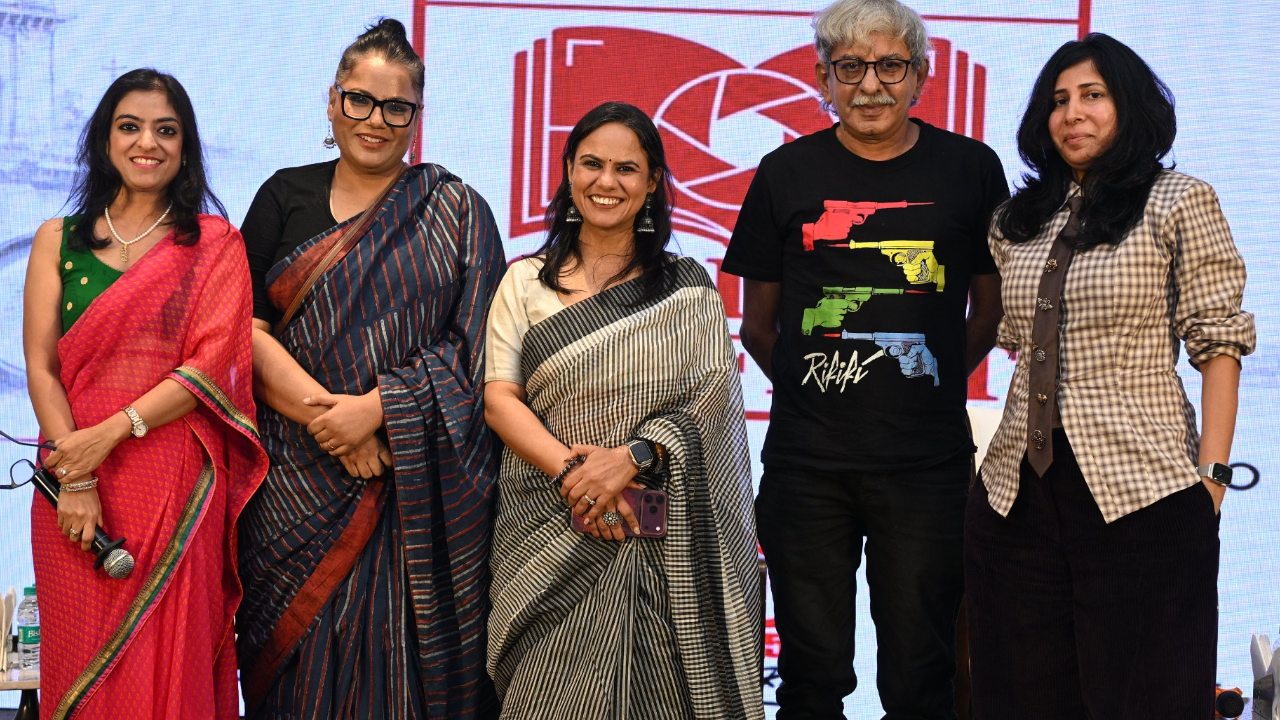
These questions dominated a discussion titled “Murder, She Wrote: The Portrayal of Women Characters in Crime Stories — A Stereotypical Effect,” moderated by Ankita Kumar, featuring filmmaker Sriram Raghavan, writers Smita Singh and Reshu Nath, and producer Aparna Purohit.
Kumar questioned whether Hindi cinema had moved beyond portraying women as virtuous heroines or seductive vamps to embrace morally complex female characters.
Smita Singh: Trauma should not become a moral permission slip
Writer Smita Singh argued that female criminals should not always require traumatic backstories to justify their actions.
“Unka trauma jo hai woh unka ek moral permission slip ban jaata hai,” she said, questioning why suffering becomes a moral justification for wrongdoing.
Recalling her research at Tihar Jail, Singh spoke about the brutality of crimes committed by women. Citing Pramila in Raat Akeli Hai, she described a woman whose greed and desire to protect her son made her complicit in violence.
“One of the things that I’m most scared of as a woman is the strong female character,” Singh said, arguing for complex individuals rather than idealised women.
Sriram Raghavan: Every criminal does not need an explanation
Discussing Urmila Matondkar’s character Sarika in Ek Hasina Thi, Raghavan acknowledged that her victimisation was essential to that particular revenge narrative but rejected the idea that every female criminal needed justification.
“You don’t need to give an explanation every time,” he said.
Referring to Merry Christmas, he suggested that the female protagonist could be an unreliable narrator. He also cited Tabu’s manipulative character Simi in Andhadhun, emphasising that compelling characterisation depended on writing.
“It’s all about the writing actually,” he said.
Reshu Nath: Stories are not babysitters
Writer Reshu Nath maintained that audiences were ready for morally ambiguous women.
“Stories are not babysitters. They are not supposed to be nannies,” she said, arguing that characters need not provide moral lessons.
“As long as you can keep the audience engaged with what next, they don’t care,” Nath added.
Aparna Purohit recalls the challenge of greenlighting Mirzapur
Purohit recalled the challenges of greenlighting Mirzapur during her tenure at Amazon Prime Video India. She insisted that women in the series, particularly Beena Tripathi, played by Rasika Dugal, needed agency rather than decorative roles.
“Every character, especially the women, have to have agency. They can’t be just wallflowers and props,” she said.
Why is a woman’s morality questioned more than her crime?
Purohit observed that women were judged not merely for their crimes but for failing expectations surrounding motherhood, marriage and sexuality.
“Often the crime becomes secondary. It’s the morality around her that becomes the talk point,” she said.
The panel also debated whether creators changed endings to ensure female criminals faced punishment. Singh stressed that perspective shaped audience sympathy, while Purohit warned that catering to predictable expectations diminished storytelling.
Crime cannot be separated from society
Raghavan recalled advice from a psychiatrist who had treated serial killer Raman Raghav: “Don’t treat him like a criminal. Treat him like a sick man.”
Singh argued that crime could not be separated from social structures. Discussing violence, misogyny and institutional complicity, she said, “You can’t have gender justice if you don’t have justice in your society.”
Purohit reinforced the importance of context, saying, “We live in a deeply patriarchal society where both men and women are brought up, are products of patriarchy.”
While differing on the need for backstories, the panellists agreed that female characters deserved the same moral complexity as men, including the freedom to be selfish, manipulative, dangerous and unapologetically criminal.
