


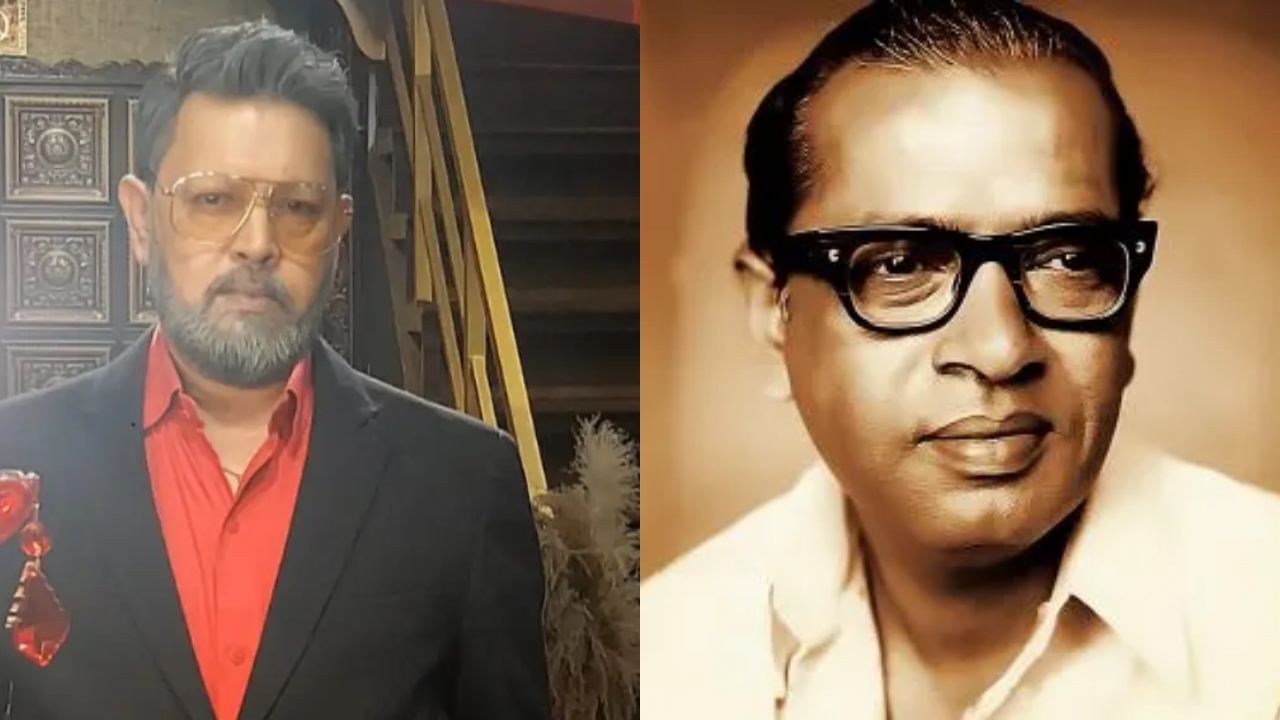
For generations of Hindi film audiences, Keshto Mukherjee remains synonymous with the unforgettable comic drunkard—a character he played with such effortless spontaneity that it became an enduring part of his screen identity. But away from the cameras, the actor was a very different man. His son, actor Babloo Mukherjee, remembers him as a serious, disciplined, and deeply caring father who kept his family far removed from the world of cinema. In this candid conversation, Babloo looks back on his father’s career, his lesser-known performances, the persistent myth that he drank in real life, and the legacy he left behind—both as an actor and as a family man.
How do you remember your dad as a person, as an artist, and as someone who was such an integral part of Indian cinema?
As an artist, people always say he was a legend in his own style. I knew him as very helpful and polite. I never saw him act aggressively. From what I’ve heard from others as well, he was a very helpful person, a loving husband, and a loving father.
Do you feel Keshto da received his full due as an artist?
From an interview I once heard, whatever he achieved and received was far more than what he expected when he first came to Bombay. When someone comes to Bombay to earn a living, what do they want? A big house, good earnings, stardom… and he got all of that, plus respect and global recognition. So he was very happy and content with whatever he received. Given his distinct look, one couldn’t have expected so much, yet he received way more than he expected.
What do you remember of him as an artist?
I was never with my dad on film shoots because he kept us completely away from that world. Everything I knew about him was from home, as a husband and a father. I didn’t know his outside world firsthand. As an actor, I never saw him rehearsing at home before going for a shoot. In those days, actors usually received their scripts directly on set. He performed spontaneously. Even during rehearsals, he would deliver the lines. Whatever extempore touches he added—laughter, body language, eye movements—the director would capture by calling for close, mid, or wide shots to cover his gestures.
Was he cheerful at home, or was he a serious person? How was he as a father?
He was a very serious person at home. Until I was 15, I had never even seen him laugh. We hardly got to see him, and whenever we did, he would be checking on our homework, food, or clothes. He made sure to look after those details.
How did you get into acting then?
I was never supposed to act. About three months after Dad passed away, Mr. Anil Ganguly—who directed Saheb and many other films—offered me a role in his film Kaun? Kaisey? (1983), starring Mithun Chakraborty and Anita Raj. Anita Raj played my sister, and Mithun Chakraborty played my brother-in-law. I had a few scenes with them. That’s how it started, and then people started offering me work, and I got busy.
Did people ask if you were Keshto Mukherjee’s son?
Not initially. Dad passed away in 1982, and I started working that same year. By 1985, I gained recognition when my interviews and pictures started appearing in newspapers and magazines. That was when people realized I was Keshto Mukherjee’s son. I had never mentioned it before.
Was being Keshto Mukherjee’s son an advantage or a disadvantage for your career? How do you look at it today?
It became an advantage once people found out I was Keshto Mukherjee’s son. The disadvantage was that people wanted me to act like my father, which I completely refused to do. I didn’t want to mimic him.
Did he ever express a desire for bigger, more nuanced roles? A few directors like Ritwik Ghatak gave him nuanced roles, but most filmmakers cast him in comedic drunkard characters.
Yes, he did several sober roles too. In Khubsoorat, with Rekha ji and Rakesh Roshan ji, he played a character who recited poetry, and he even won an award for that performance. He got a few different roles, but overall, he was happy with the good money he was making from the roles he was offered.
Did he make sure the family was well-provided for? How did he manage his finances?
He earned immensely. He owned a 2BHK flat on Juhu Tara Road, around 1,200 square feet, which was a substantial property back then. He also owned a plot in Juhu to build a bungalow, along with several bank accounts. I only learned about many of these assets later in life when people came to tell us what he had left behind.
What happened to that bungalow plot in Juhu?
One of my dad’s friends swindled us out of it. I was too young to understand those matters, and my mother was a simple housewife who wasn’t business-savvy. So, an uncle took advantage of the situation. But it’s fine; whatever was meant to go, went. God has given us much more since.
You’ve built a successful career yourself. How do you look back on your journey?
By God’s grace, touch wood, it has been very good. I built up my own properties through my acting roles, stage shows, and other ventures. I entered real estate and the education sector. I run a school in Mira Road from nursery to 10th standard.
Despite playing iconic drunkard characters, Keshto Mukherjee didn’t drink alcohol in real life. What was his actual relationship with alcohol?
Until I was 16, I never once saw my dad come home drunk or drink alcohol at home. If someone drinks outside, even a peg or two, you can usually smell it on them. I never experienced that with him. People make up all sorts of rumors, but as his son who lived with him, I know the truth. Most people who actually worked with him confirm that Dada never drank on set.
What about his work with directors like Basu Chatterjee?
He worked with Basu Chatterjee, Ramanand Sagar, Hrishikesh Mukherjee, Bimal Roy, and many others. I remember Chupke Chupke with Hrishi da, and Musafir early in his career with Dilip Kumar and Kishore Kumar.
Did he ever discuss cinema at home?
Never. We were kept entirely separated from the film industry. We weren’t even allowed film magazines. He wanted me, as the elder son, to become a pilot, so he brought home aviation books and toy planes. For my younger brother, Ranjeet—who sadly passed away—he wanted him to become a doctor, so he brought home toy medical sets.
Are you currently taking on acting projects?
At 60, character roles for older actors are less frequent because shows often cast younger actors even for senior roles. But touch wood, I am happy doing a few age-appropriate projects, along with managing my business.
Is there any truth to the rumor about Susmita Mukherjee being related to your family?
Not at all. There is zero relation. People assume she is my sister or Keshto da’s daughter, but my dad had no daughters—only two sons. I was born in Kolkata, my dad was from Kolkata, and Susmita is from Delhi. Because we share the surname Mukherjee and have a slight resemblance, people assumed we were related.
A funny thing happened years after Dad passed away: a bank called me regarding his account and locker. When I went to claim them with proof of relation, the bank staff insisted on getting Susmita’s signature too. They refused to believe she wasn’t his daughter, saying, “You can’t disown your sister over money!” I literally had to get a written letter from Susmita clarifying that she is not Keshto Mukherjee’s daughter to submit to the bank!
