


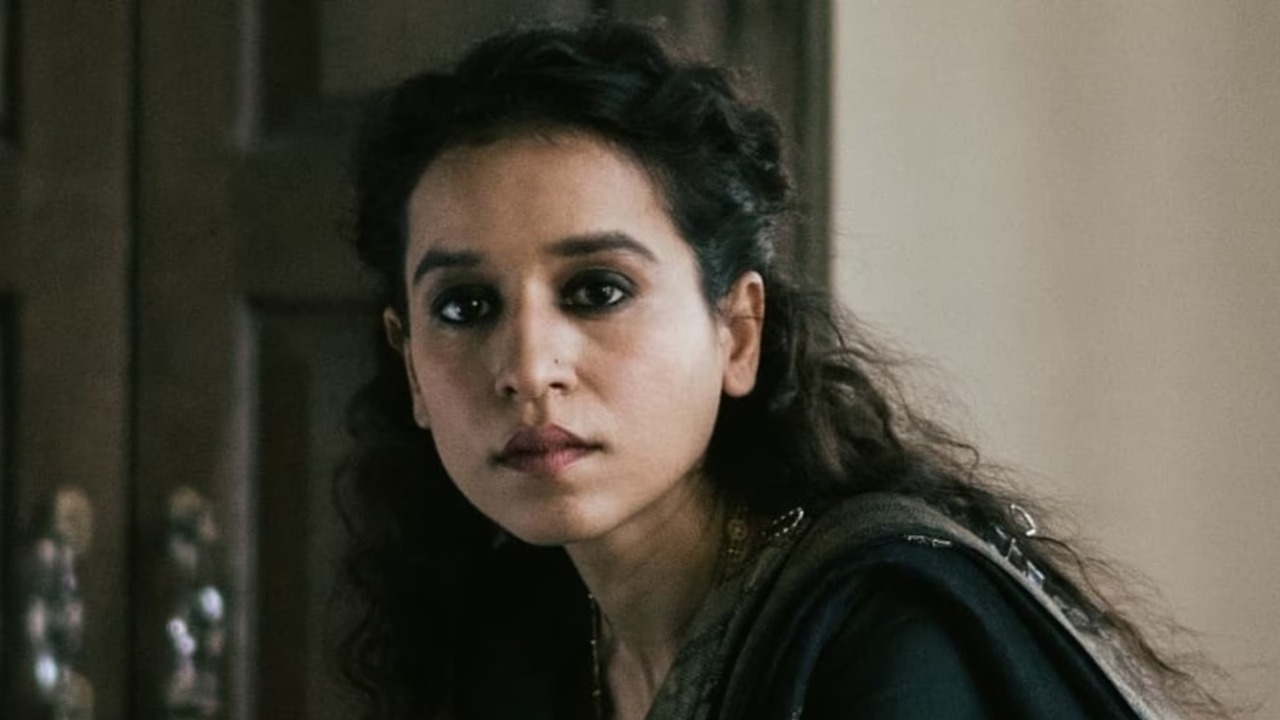
Whether playing a woman raised as a boy in Qissa, an intelligence officer in The Night Manager, or Ratna, a domestic worker navigating love and ambition in Sir, Tillotama Shome has consistently chosen roles that resist easy categorisation. In this conversation, she reflects on challenging the typecasting that followed Monsoon Wedding, her experiences working with Mira Nair and Irrfan, the need to rethink distribution for independent cinema, and the unexpected generosity she has encountered from co-stars.
Your film Deep6 presents Kolkata through a perspective that moves away from the traditionally male gaze. What elements of the city felt particularly connected to a woman’s experience?
There were many things Madhuja Mukherjee shared with me that I discovered beautifully translated into the film. Bikash Bhattacharjee’s Doll series was one of them. She also introduced me to a particular soundscape and tonal quality, including the piri solo (bamboo flute) and Park Jiha’s “Sangyeongsan”. Walking through and shooting in central Kolkata and around Howrah Bridge was a wonderful experience.
We have seen countless films where a male protagonist walks through the city and the landscape becomes part of his journey. In Deep6, locations such as the tea shop at Chandi Chowk and Tollygunge, including Mitul’s house in South Kolkata, create a different kind of map. It is a city traced through a woman’s footsteps, allowing an unfamiliar and previously unseen Kolkata to emerge.
Independent films often struggle to get sustained theatrical releases despite critical appreciation. What needs to change in the distribution system to help films like Deep6 find larger audiences?
Everyone and their aunties are asking the same question! As an actor and a very young producer, I have heard many conversations about this and about possible ways forward.
Apart from niche theatrical models, there is Video on Demand, digital self-distribution, OTT platforms and curated streaming services. There are also people exploring the possibility of selling digital screening rights to film schools, libraries, cultural institutions, colleges and other alternative spaces. I think we need to keep expanding our understanding of where and how independent films can find their audiences.
After Monsoon Wedding, you were frequently offered similar roles. How consciously did you try to move away from that image with characters such as The Consultant in Hindi Medium and Angrezi Medium, and Lipika Saikia Rao in The Night Manager?
In the early days, you simply did not have the privilege of saying no to work. Those early days were long years of waiting. I could say no to a job if I felt I was not ethically or politically aligned with it. But I could not afford to reject work simply because I felt I was being stereotyped.
That privilege came much later, after I played Ratna in Sir, directed by Rohena Gera. The casting for Hindi Medium happened because of Honey Trehan and Manpreet Bacchhar. Honey really fought for me to be part of the film and strongly encouraged me to do it because he wanted to break the deep class bias that had developed around me after Monsoon Wedding.
Do you have any memorable moments from the sets of Monsoon Wedding?
It was a golden set. Mira made me feel like I was the centre of her universe. Somehow, she managed to make every actor feel that way. It is quite a feeling to be the object of her affection and attention.
I remember very clearly when the legendary photographer and activist Nan Goldin visited our set to shoot some stills. Shortly afterwards, she had an accident, fell into an empty swimming pool, injured her leg and had to leave. The whole experience feels like a beautiful fever dream.
To work with and watch masters such as Naseeruddin Shah and Kulbhushan Kharbanda at play was beyond my comprehension. They were both incredibly kind to me. My love interest in the film, the wonderful Vijay Raaz, and I barely spoke to each other. I guess we were both shy.
And, of course, there was working with Irrfan.
What was it like working with Irrfan?
I would never have missed an opportunity to work with Irrfan as a co-actor, even if it were for just one scene. The timing of things was such that any day spent with him was a day well spent.
Your performance as Ratna in Sir was widely praised for capturing dignity and quiet resilience with very little dialogue. How did you approach that?
It was all there in the script. Rohena had mapped out every beat and given me a very simple through-line for the character: no matter what happens, Ratna never loses her sense of dignity. I simply held on to that throughout the film.
We give too much importance to dialogue. In everyday life, we communicate so much without saying anything.
In Qissa, you played Kanwar, a woman raised as a boy in post-Partition Punjab. How did you prepare for such a complex character?
On that film, I met one of the finest directors I have ever worked with. Anup Singh was not only a marvellous director but also an incredibly generous one. He gave me very evocative direction, but he also gave me tools that I could continue using as an actor long after I had left his set.
He introduced me to classical Chinese paintings and Bibi Noora’s songs. He arranged Punjabi lessons for me and training in an ancient martial art, kalaripayattu. On top of that, I was working with actors whom I could watch endlessly for hours.
That film became the film school I never attended. So, although I was not prepared to play Kanwar when I began, I was buzzing with inspiration every single day.
You have a Master’s degree in Educational Theatre from NYU and have taught drama in high-security US prisons. How has that experience influenced your approach to performance?
It was not so much the degree itself. The learning and training I received under a master process worker like Chris Vine changed the way I understood causality.
Thanks to Chris, I had the opportunity to work at a high-security prison at Rikers. Working with the inmates there gave me an opportunity to observe the human condition with a visceral kind of acuity. It profoundly changed the way I look at people, and therefore, it deeply changed the way I approach performance.
You worked with Sunny Deol in Ikka. What was he like as a co-star? Did anything about him surprise you?
It is wonderful to see an action hero like him be so openly vulnerable. That surprised me, in the best possible way.
He is an extremely generous co-actor. At one point, he let a fly sit on the waterline of his eye because he did not want to disturb my close-up. According to him, the take was going well, and he did not want anything to affect it.
Honestly, I did not see that coming. I don’t expect someone to put themselves through that kind of discomfort simply to avoid disturbing a co-actor’s take. What a gentleman—and more.
