


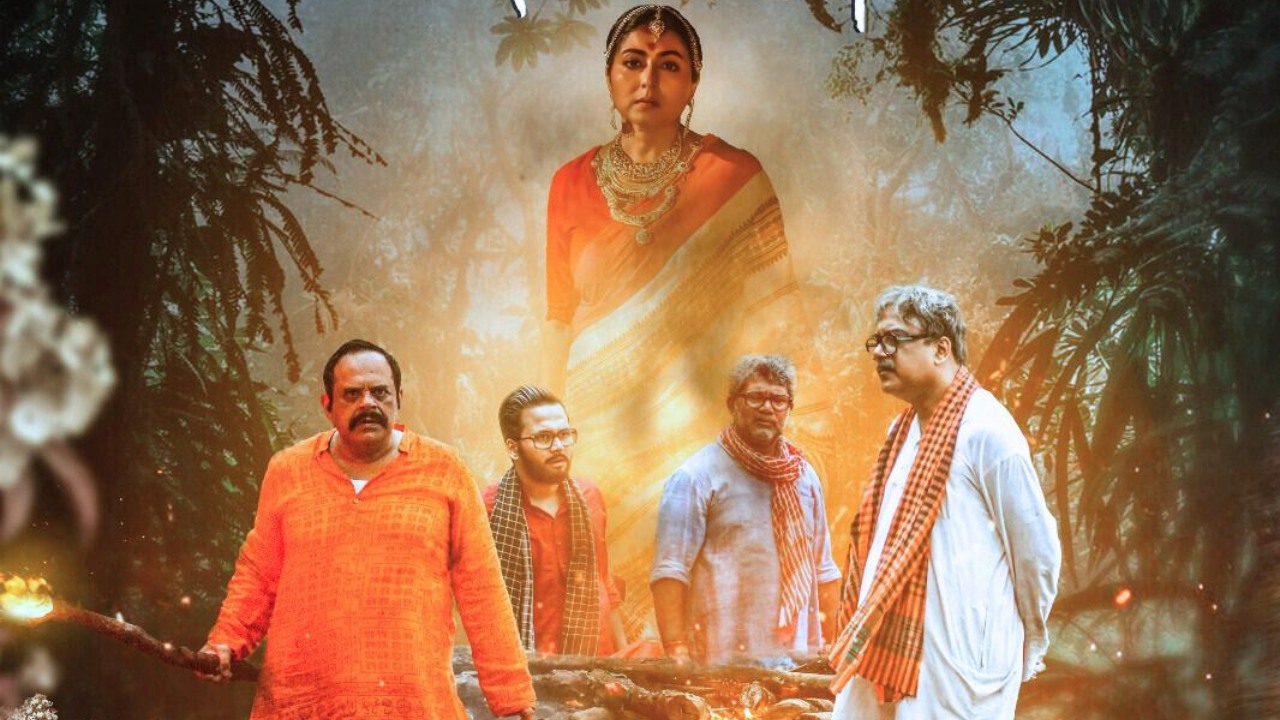
Acclaimed filmmaker Sekhar Das’s Pagla Ghora (Wild Horse), based on the celebrated play by legendary playwright and theatre visionary Badal Sircar, will have its international festival premiere in Paris as the Opening Film of the Gange sur Seine Film Festival, at the prestigious Club de l’Étoile.
The selection is particularly significant during the centenary year of Badal Sircar’s birth. One of the most influential figures in modern Indian theatre and a pioneering voice of the Third Theatre movement, Sircar transformed the language, space and practice of theatre. His work continues to resonate because of its incisive engagement with society, human relationships and the complexities of human behaviour.
The Film
Set at night in a cremation ground in a remote forest in West Bengal, Pagla Ghora brings together four men from different professional backgrounds who gather for the last rites of a young woman who has died by suicide.
As they drink and play cards beside the burning pyre, the spirit of the nameless deceased woman enters their conversation, unseen and unheard by them. Her spectral presence gradually prompts the men to reveal stories about the women in their lives.
Four different accounts emerge, each exposing patriarchal cruelty, social hypocrisy, male dominance and moral cowardice. All four women meet tragic ends.
At the heart of the narrative is the nameless young woman’s own regret at never having experienced passion or love. The emotional emptiness of a life without meaningful human connection ultimately leads to her suicide.
Through this haunting narrative, Pagla Ghora explores desire, repression, loneliness, patriarchy, emotional isolation and the silence surrounding women’s suffering.
Sekhar Das – Director
For Sekhar Das, the Paris screening carries a deeply personal resonance.
“It is not simply another festival screening. It feels like a homecoming of sorts.”
Badal Sircar himself had spent a period of his life in Paris, making the film’s presentation in the city during his centenary particularly poignant.
“For me, this screening is therefore both a celebration of cinema and a tribute to Badal Sircar.”
Das sees the Club de l’Étoile screening as an opportunity for the film to reach not only the Bengali community but also French audiences, cinephiles, artists and those interested in Indian theatre and cinema.
The film had earlier had a private screening in Cannes following an invitation from Angénieux. The Paris presentation now offers an opportunity to share it with a much wider audience.
Dr Prabir Bhoumik – Producer, Swabhumi Entertainment
Producer Dr Prabir Bhoumik describes the Paris opening as a moment of immense pride and an important cultural opportunity for a work rooted in Bengal’s rich theatrical heritage.
“Cinema can travel beyond language, geography and cultural boundaries.”
The production is backed by Swabhumi Entertainment, whose creative endeavour in recent years has included bringing the works of significant Bengali literary and theatrical figures to contemporary audiences through cinema.
For Swabhumi Entertainment, such adaptations are not simply exercises in preservation. They represent an attempt to renew the dialogue between important works of the past and contemporary audiences, allowing their ideas and universal human concerns to travel across generations and cultures.
The Paris journey of Pagla Ghora therefore represents an extension of that larger creative vision- taking a work deeply rooted in Bengal while allowing it to enter an international cultural conversation.
Bipasha Ghoshal – Executive Producer
Executive Producer Bipasha Ghoshal has been an integral part of the production, working tirelessly behind the scenes to help bring the film to fruition.
Her sustained involvement in the production, coordination and execution of the project has been an important part of the film’s journey from conception to its international presentation.
Gargee Roychowdhury
Gargee Roychowdhury had read Badal Sircar’s original text before joining the film and was conscious of its origins as a proscenium play.
“Sekhar Das encouraged me not to restrict myself to the theatrical context, but to explore its possibilities as a wider cinematic expression.”
She describes the production as a meeting of experienced practitioners and a new generation of culturally and professionally accomplished film-production entrepreneurs.
“It is always an honour and a privilege to be directed by such an internationally feted auteur.”
Sujan Mukhopadhyay
For theatre practitioner and actor Sujan Mukhopadhyay, Pagla Ghora remains an extraordinary exploration of human nature, relationships and vulnerability.
“Badal Sircar’s writing is remarkable in the way it observes human beings, their relationships and the complexities of life.”
He particularly valued the rehearsal process before filming and the opportunity to explore the characters and text in depth with the director.
“The narrative is not merely a Bengali play. It is an Indian work in the truest sense.”
Rajatava Dutta
For Rajatava Dutta, the film’s journey from Bengal to Paris is an emotional milestone.
“Pagla Ghora has galloped myriad distances, and now it has finally reached across international shores to Paris.”
He sees the Paris premiere as the beginning of a much longer journey and hopes the universal human questions at the heart of Badal Sircar’s work will resonate with audiences across geographical and cultural boundaries.
Rwitobroto Mukherjee
Rwitobroto Mukherjee, who plays Himadri, describes being part of Pagla Ghora during Badal Sircar’s centenary year as a privilege.
“He was not just a playwright; he transformed the language of Indian theatre.”
He also highlights Sekhar Das’s cinematic interpretation of the original text and the contribution of the film’s creative team.
“He has retained the essence of the play while making the moments feel truly cinematic.
For Rwitobroto, working alongside experienced actors and practitioners made the project a particularly enriching experience.
The Journey Ahead
The Paris premiere marks a new chapter in the journey of Pagla Ghora.
Conceived as a tribute to Badal Sircar during his birth centenary, the film has travelled from the theatrical heritage of Bengal into the language of cinema and now onto an international platform.
The Paris screening is therefore not being viewed by the team as an endpoint, but as the beginning of a wider journey. The hope is that Pagla Ghora will travel to audiences across India and beyond, allowing viewers from different cultures to discover the universal human questions embedded in Badal Sircar’s work.
As Rajatava Dutta says:
“The Paris premiere is not an ending or even a destination. It is the first major step of a much longer journey.”
And, in the words of Gargee Roychowdhury:
“Now, the moment has come to let our Pagla Ghora—our ‘mad horse’—run free.”
The journey that began with a tribute to one of India’s most influential theatre practitioners now moves across languages, cultures and borders.
Cast
Gargee Roychowdhury | Sujan Mukhopadhyay | Rajatava Dutta | Jayanta Hore | Rwitobroto Mukherjee | Chandreyee Ghosh | Srijita Saha | Deerghoi Pal
Production Credits
Director: Sekhar Das
Based on: Badal Sircar’s Pagla Ghora
Producer: Dr Prabir Bhoumik
Executive Producer: Bipasha Ghoshal
Cinematography: Supratim Bhol
Editor: Arghyakamal Mitra
Music: Indraadip Dasgupta
Art: Manas Roy
PR & Marketing: Rana Basu Thakur
Sound Design: Anindit Roy & Adeep Singh Manki
Costume: Bipasha Ghoshal
