


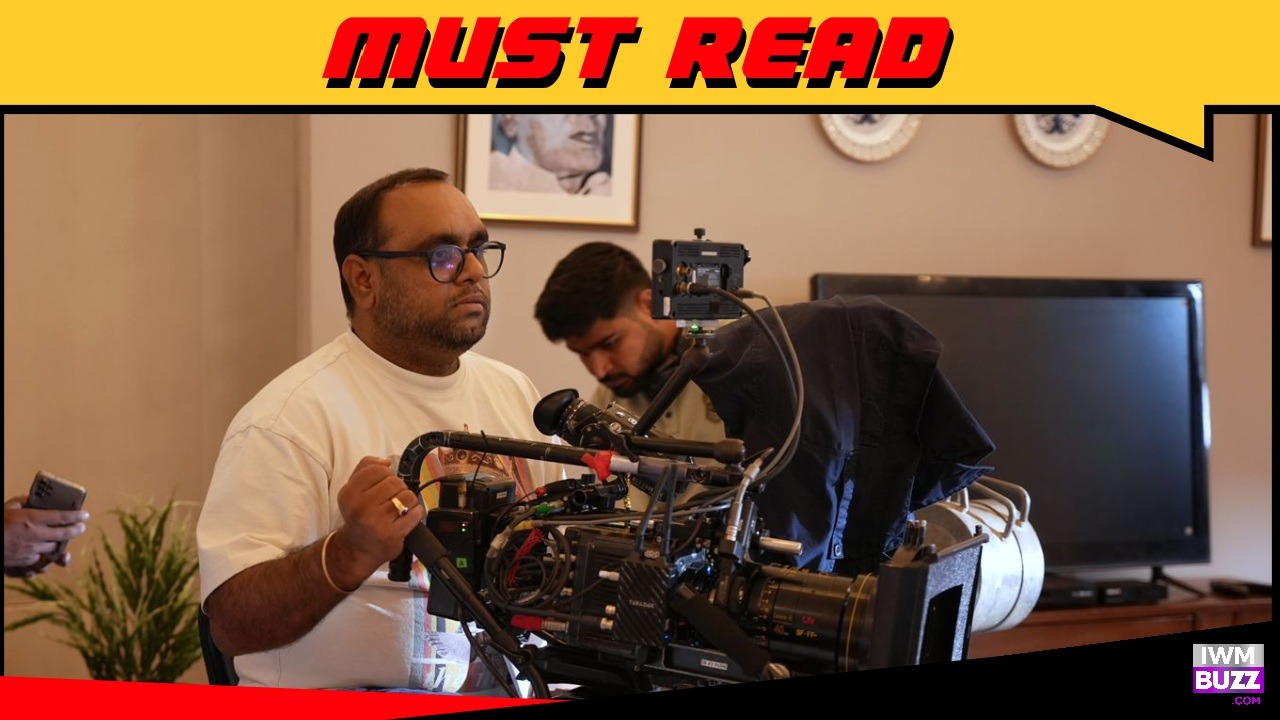
Director Puneet Prakash has carved a niche for himself with his grounded, character-driven storytelling and a sharp eye for political and emotional detail. Known for his restrained visual approach, he recently directed Maharani Season 4, on SonyLIV, a chapter that expanded the series’ political canvas while staying true to its core. Puneet’s direction has been noted for seamlessly introducing a new world and characters without losing the essence that made Maharani so compelling.
In a chat with IWMBuzz.com, Puneet spoke about the response to Maharani Season 4, his journey so far, his goals for 2026, and more.
How has the response been for Maharani 4?
The response to Maharani 4 has been deeply encouraging for all of us. We were always aware of the strong foundation the previous seasons had built, so this chapter was approached with a great sense of care and responsibility. What has been especially meaningful is the way audiences have connected with the new characters that were introduced in the season. These characters fit in the world effortlessly and managed to find the love of the audience. The appreciation for the writing, cinematography, music, and the understated, rooted visual approach has been reassuring.
How did it feel when you got on board a hugely successful web series and held the responsibility to take the story to further heights in Season 4?
Stepping into a show as loved as Maharani came with a healthy sense of pressure, and I think that’s important. The success of the earlier seasons had already set a strong benchmark, but since this season took a leap of more than a decade and along with many new characters, we introduced a whole new world of Delhi and central politics in this season. So the focus was never on trying to outdo what existed, but create a new world while staying true to the ethos of what Maharani as a show happens to be, and to allow it to evolve naturally. Holding that responsibility was challenging, but also deeply fulfilling, because it pushed us to be more honest, more restrained, and more thoughtful in the storytelling.
How satisfying has the journey been for you?
The journey has been extremely fulfilling on a personal and creative level. Maharani allowed me the space to explore a whole new world of storytelling, along with characters with different shades and the politics at its highest level. More than the craft of storytelling, it made me reinvent myself to explore the art of it, and it is something I value deeply as a director. Working with such a committed cast and crew, and being part of a world that audiences are already so invested in, made the process even more rewarding. What stays with me most is the sense of collective ownership everyone brought to the table. Seeing that connection with viewers has made the journey truly satisfying.
As a filmmaker, what are the kinds/genres of content that draw you in?
I am instinctively drawn to stories rooted in human behaviour — narratives where emotions, power dynamics, and moral choices shape the drama. Political and social stories interest me deeply, but beyond genre, I look for emotional conflicts and layers in the characters that go beyond black and white. I enjoy worlds that feel lived-in, where silence and subtext speak as loudly as dialogue.
On a more personal note, I’ve always been fascinated by the idea of exploring a time-travel film to a dystopian world & Zombie films. More than any genre, I fall in love with the story and what I am getting to tell in the story.
What are the goals ahead?
Going forward, my focus is on continuing to tell honest, character-driven stories while exploring newer spaces creatively. I’m currently working on a feature film produced by JA Entertainment, backed by John Abraham, in collaboration with Bake My Cake Films, which is still in its early stages. The larger goal is to keep evolving as a storyteller and build work that feels sincere, relevant, and lasting.
Is your approach towards work on hand differently crafted for ads, shorts and web series? Explain
Yes, the approach does shift with the format, because each one demands a different relationship with time and storytelling. Ads require sharp clarity and impact within a very limited duration, so every frame has to communicate instantly. Shorts allow more creative freedom but still demand precision and strong intent. Web series, on the other hand, give you the space to build worlds, characters, and emotional arcs gradually. That said, what remains constant across formats is the focus on character exploration, strong writing, and emotional authenticity — the tools may change, but the core sensibility stays the same.
