


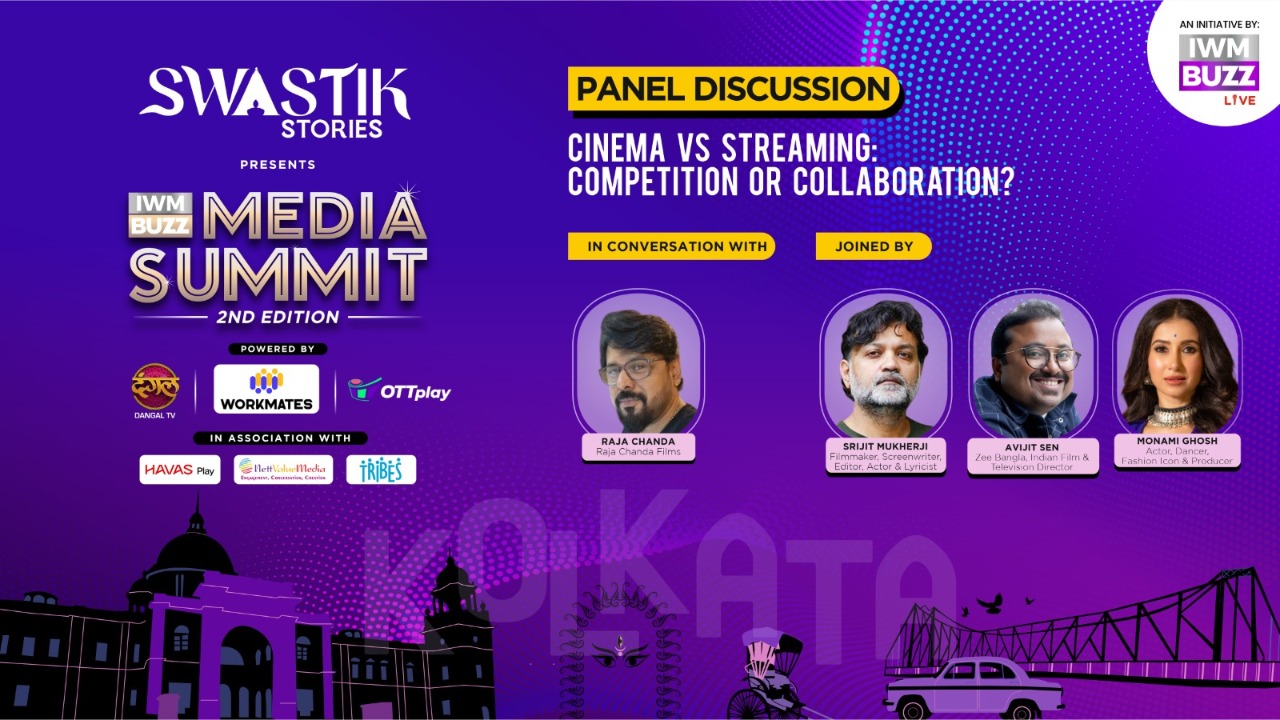
The discussion between cinema and streaming platforms has a dramatic aura, as if one should replace the other. But the Bengali film industry’s talk conveys a totally different meaning. No collapse is happening; this is an advance—one that storytelling is learning to adapt without losing the emotional core. The last session at the second edition of IWMBuzz Media Summit in Kolkata was headed by Raja Chanda and featured Srijit Mukherji, Avijit Sen, and Monami Ghosh, and explored the thin line between competition and collaboration under the premise of cinema Vs streaming.
Traditional cinema continues to deliver the same experience: grand scale, a live audience, and instant engagement. In contrast, streaming platforms have enabled deeper exploration of stories. Previously introduced characters can now be developed with greater nuance, and their relationships depicted with greater depth. Rather than diminishing creativity, this evolution has enhanced it. Each format now serves the storytelling demands of different kinds of narratives.
The discussions have revealed one major outlook—the audience is changing. The phrase “Bengali audience” is no longer valid. Preferences differ significantly from one generation to another, from one region to another, and according to different viewing habits. As a result, trying to predict what people want can be very misleading. A lot of filmmakers today think that honesty is the best policy, as it works better than calculation in the end. Personal conviction gives rise to stories that are more likely to get into the hearts and minds of the audience than those designed around market assumptions.
Another crucial aspect that came up was technology, including artificial intelligence. Gradually, it has overcome the fear that it would eventually become a threat, and today it is recognised as a powerful aid tool. AI is involved not only in sound and visuals but also in post-production support, gradually breaking the limitations that have been holding back regional cinema. It does not take creativity away; rather, it serves as a collaborator. The imaginative input of people still makes a film’s emotional truth.
Social media has been a significant factor in how artists and audiences interact. It offers perks like direct access, wider visibility, and instant response. Besides the good, it also brings along noise, pressure, and sometimes non-constructive criticism. The difficulty lies in being very selective in using these social media platforms—listening without being drowned out.
Bengali cinema, at its core, is at a very significant and meaningful point. Technology, in this case, has been and remains an opposing force to tradition. When applied with care, they can even fortify one another. The future will be for narratives that are still deeply connected with cultural truth but have also gained the ability to be told through new channels.
Note: The transcription and summarisation above have been partially generated with the help of AI.
Watch the session here to experience a full-fledged, insightful session:
The second edition of IWMBuzz Media Summit in Kolkata was presented by Swastik Stories, powered by Dangal TV, Workmates and OTT Play. Associate partners Havas Play, Nett Value Media and Tribes. Partners—White Apple, Just Lateral Think Ink, Decalogue and The Heritage Academy. An initiative by IWMBuzz Live.
