


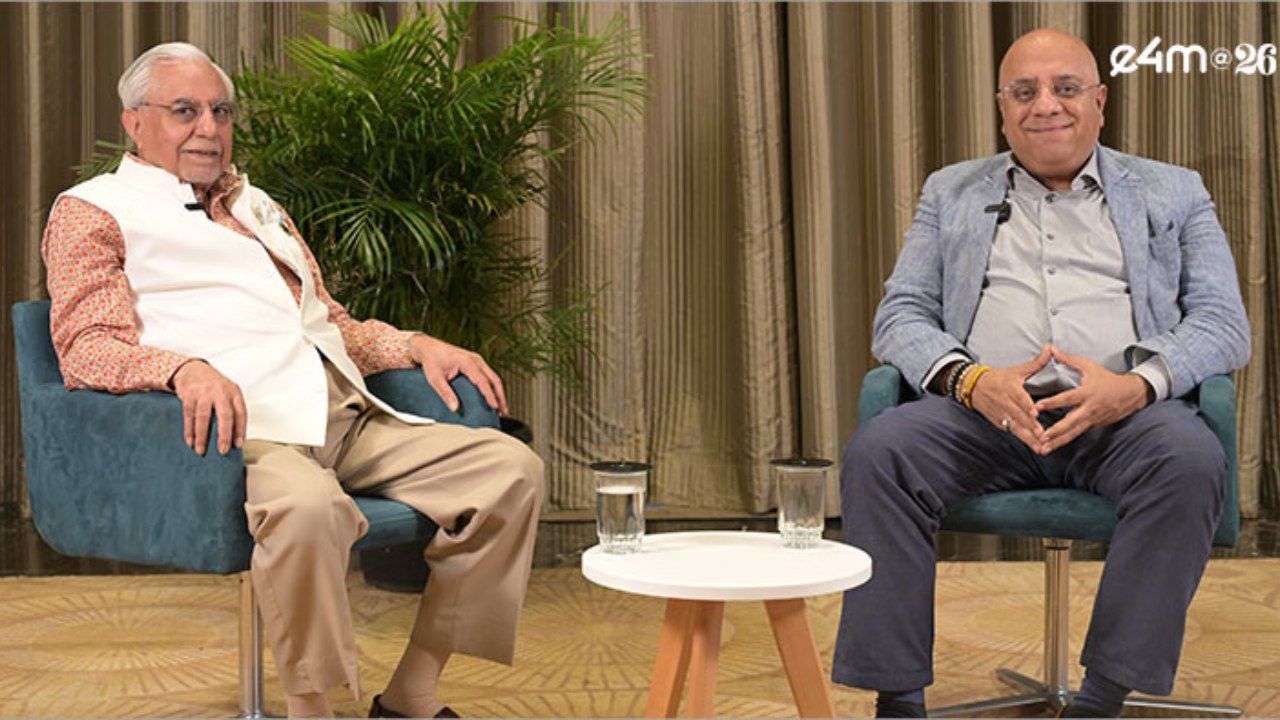
The Indian media industry has seen its share of reinventions: from the analogue cable boom of the 1990s, to the DTH wars of the 2000s, to the streaming avalanche reshaping everything today. But very few figures have been present at every inflection point, shaping the ground rather than simply standing on it. Dr. Subhash Chandra, Chairman of the Essel Group and the man who built Zee Entertainment into a national institution, is one of them.
In a wide-ranging conversation with Dr. Annurag Batra, Chairman and Editor-in- Chief of BW Businessworld and the Founder & Editor-in-Chief of the exchange4media Group, on the occasion of his 75th birthday, Chandra was characteristically unguarded about the failures he owns, the battles he still wants to fight, and the conviction that Zee’s best chapter is still being written.
The man who doesn’t count years For someone who has been in business for nearly six decades, Chandra wears age with an almost theatrical indifference. He turned 75 on November 30, 2025.
“That’s a number for me, there’s nothing else,” he said of turning 75. “I feel as I should be feeling at 35 or 37.” Those who work with him would agree, by all accounts; he arrives at the office on weekends, makes decisions like a man with decades ahead of him, and holds court with the same relentless energy that characterised the early Zee years.
That energy, he insists, was forged not by ambition alone but by necessity. When his family’s business collapsed in 1966, Chandra, barely a year into engineering college, received a postcard asking him to return home. The family couldn’t afford to keep him enrolled. He was 17. “Since then, I have always pushed my boundaries. I had to push my boundaries,” he said. “And if it may not sound very arrogant, that became my nature.”
What followed was a textbook case of Indian entrepreneurship in its most unrefined, organic form: a young man trading jute sacks and dal by-products in Hisar, spotting margins where none existed, and building the habit of growth through sheer necessity.
Thirty-three years of Zee, and counting Zee Entertainment, which turns 34 this year, is still today the largest Indian- language television network by brand recognition, even as its financials have spent the better part of three years under pressure. In February this year, Zee TV, the flagship Hindi GEC from Zee Entertainment Enterprises Ltd, attained its highest viewership in four years.
The Pitch Madison Advertising Report 2024 pegs the Indian television advertising market at approximately ₹30,000 crore, with general entertainment and news channels continuing to command the lion’s share. Yet Zee (once the undisputed market leader) has seen its stock tumble from a peak market capitalisation of roughly $14 billion to under $1 billion at the time of this conversation.
Chandra is clear-eyed about why. “Because of this incident with us as promoters on 25th January 2019, Zee also got a negative rub-off,” he said. The IL&FS crisis of late 2018 triggered an asset-liability mismatch across large corporate groups. Essel was among those caught in the crosswind. Chandra’s promoter holding in Zee fell from 42% to under 5%. What followed (an attempted hostile takeover, SEBI proceedings, a three-year Sony merger process that ultimately collapsed) left the company rudderless at exactly the moment it needed to pivot.
“All these things derailed the process of Zee as a company, and that showed in its performance,” he said. “The pivoting that needed to happen at that time did not take place.”
The 43,000 crore chapter On 26th January 2019, the day before the conversation that produced this article, Chandra sat in a boardroom with 26 lenders and told them what had happened. No lawyers, no strategic opacity. He committed, along with his sons Puneet and Amit, to repay every rupee. “We paid ₹43,000 crore by selling our crown jewels and everything,” he said. “I am not regretting anything – rather I feel much lighter, much happier today.”
In an era when large Indian industrialists have regularly taken haircuts on debt, declared insolvency, or restructured obligations through bankruptcy proceedings, the episode stands as a significant outlier. Chandra makes no great show of it, but the decision (and its execution) has reframed how he is regarded, at least among those who followed the detail.
Re-entering the building he built When the Zee board invited Chandra back to help stabilise the company in 2022-23, he found an organisation that had settled into the comfort of its own legacy. “I had to clean that up. I had to request all of them to go. They were nice people, very good people – but not willing to accept the failure,” he said. “I believe that unless you accept your failure, you will not be able to correct it.
The turnaround metrics, while early, are moving in the right direction. Zee TV, the flagship GEC, now has four shows in the top 10, a notable recovery from a period when the channel had no show in the top 20. Overall, Zee’s share of eyeballs has climbed from 17% to 18.8% over the past year, with a stated target of 20% and beyond. Chandra frames this less as a rating victory and more as a signal of cultural reconnection with a viewership that once treated Zee as its own.
“Viewers who deserted us are coming back,” he said. “We have pivoted ourselves to an omni-content strategy – you create content irrespective of where the viewer is. It may be on linear TV, connected TV, digital, or social media.”
On the advertising sales side, the recalibration is equally deliberate. Chandra described meeting roughly 300 of Zee’s 500-strong advertising sales team over the past few weeks. “I am telling them you must solve your advertisers’, your clients’ problem. He is the one who is paying your salary,” he said. “Somewhere, we became simply transactional. You would say, this is our rating, this is the rate. We started playing games on that.”
The ICL admission, and what was never said publicly One of the more candid moments in the conversation came when Chandra spoke about the Indian Cricket League, the rebel T20 tournament Zee launched in 2007, which is widely credited with catalysing the BCCI’s creation of the IPL. The popular narrative that the BCCI killed the ICL through regulatory pressure and player bans is only partly accurate in Chandra’s telling.
“I am today, for the first time, perhaps publicly admitting this,” he said. “ICL mein humne galtiyan ki. Jiski wajah se ICL ko close karna pada.” He declined to specify the mistakes in detail, saying, “one to one, main kabhi bata doonga,” but said that by the second year, losses had shrunk considerably, and a breakeven by year three was within reach. “Fourth year onwards, it would have flown.”
The IPL, now a ₹15,000+ crore annual advertising property by most industry estimates, stands as perhaps the most expensive consequence of those unnamed errors.
Zee News, and the ego of incumbency Chandra was similarly candid about Zee News, which was for years the most- watched Hindi news channel in the country and a significant revenue contributor. “When a person is number one, he gets ego,” he said. “We gave full liberty, full freedom – so they wanted to be close to the political forces rather than looking after the viewer.” He did not elaborate, but the implication was clear: editorial culture had drifted from the audience-first instinct that built the brand. The correction, he believes, is now underway.
What’s next: a global first, if it works
Perhaps the most intriguing signal of the conversation was Chandra’s suggestion that Zee is working on something within the next two years that, “if we succeed, will be a very big game changer for the whole industry – not only in India.” He did not specify further, but in the context of a media landscape being radically reshaped by artificial intelligence, and with global broadcasters scrambling to define their role in an AI-native content ecosystem, the hint carries weight.
For an entrepreneur who built India’s first private satellite television network in 1992, who pioneered cable distribution infrastructure when there were 500,000 cable operators in the country, and who launched a challenger cricket league before T20 was a commercial category, the ambition to do something first is entirely in character.
“The action of that vitality in the present moment will be dynamic,” he said, distilling his philosophy for entrepreneurs into something close to a koan. “The fruits of that will flow and make you glow in the future.”
The hair has gone salt-and-pepper. Everything else appears unchanged.
