


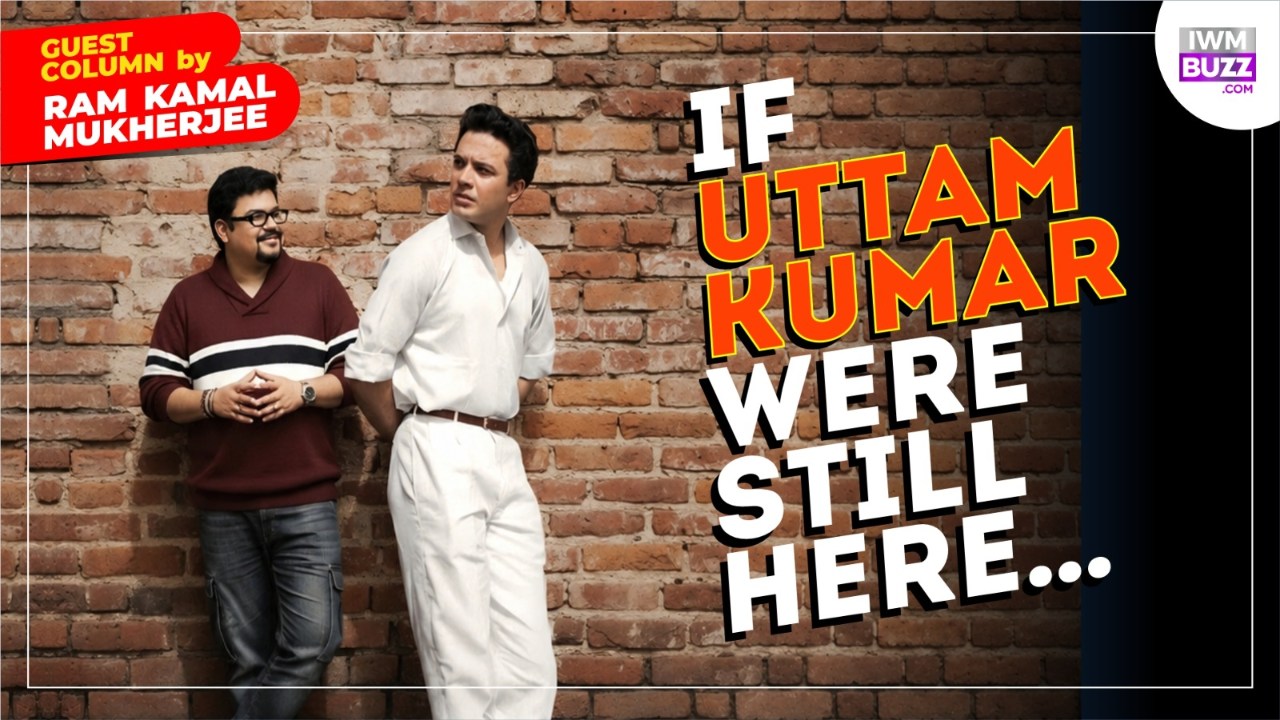
For generations of Bengalis, Uttam Kumar has been more than an actor who appeared on the silver screen. He has been a part of our growing up, our romantic imagination, our conversations, our songs, our nostalgia. His smile, his voice, his mannerisms and that unmistakable screen presence have somehow become woven into the collective memory of Bengal.
So when IWMBuzz asked me a rather unusual hypothetical question—if Uttam Kumar were alive today, which five contemporary Bengali films would I cast him in?—I realised how difficult the question actually was.
How do you choose only five characters for an actor who seemed capable of making almost every character his own?
Yet, as we celebrate the birth centenary of Mahanayak Uttam Kumar, I decided to indulge in this beautiful fantasy.
Not as an attempt to replace the actors who eventually played these roles. Not even as a comparison.
But simply as a filmmaker’s dream of watching Uttam Kumar walk into some of the most memorable stories of contemporary Bengali cinema.
And imagining what magic he might have created.
1. Dosar — Rituparno Ghosh
If I had to begin somewhere, I would begin with Rituparno Ghosh’s Dosar.
I would have loved to see Uttam Kumar as the husband who is forced to confront his own guilt after his extramarital affair is exposed.
There is something particularly poignant about imagining Uttam Kumar in such a morally grey, emotionally wounded character. The man who once embodied the romantic hero of Bengal would suddenly have to confront betrayal, guilt, silence and the painful consequences of his choices.
And perhaps, inevitably, our knowledge of Uttam Kumar’s own personal life would make the performance even more haunting.
Much has been written and discussed about his relationship with actress Supriya Devi and their life together, while his marriage to Gauri Devi continued. I would never want to reduce an actor’s performance to his personal life, but as a filmmaker, I cannot deny the fascinating emotional possibilities such a casting would create.
I often wonder how Rituparno-da would have directed Uttam Kumar.
His silences. His eyes. His pauses.
Perhaps Rituparno would not have needed Uttam Kumar to say much at all.
A look from the Mahanayak might have told us everything.
And in this imagined Dosar, I would have loved to see Aparna Sen opposite him, rather than Konkona Sen Sharma.
Just imagine those two extraordinary performers sharing the same frame.
It could have been devastatingly beautiful.
2. Belasheshe— Shiboprosad Mukherjee and Nandita Roy
My second choice would be Belasheshe.
I would have loved to see Uttam Kumar play the character portrayed so beautifully by Soumitra Chatterjee.
There is a quiet sadness in the idea of an ageing husband trying to prepare his wife to live independently—to make her self-sufficient, even as he knows that one day he may no longer be beside her.
That is the kind of emotional territory where Uttam Kumar could have been extraordinary.
He had the rare ability to communicate affection without sentimentality and pain without melodrama.
And in my imagination, I would have cast Supriya Devi opposite him.
To see Uttam Kumar and Supriya Devi together again, portraying an elderly couple looking back at a lifetime spent together, would have carried an almost unbearably powerful emotional resonance.
Their shared history—both real and imagined through the prism of cinema—would have added layers that no script could possibly manufacture.
The audience would not merely have watched two actors.
They would have watched two legends carrying decades of Bengali cinema in their eyes.
And perhaps, for one last time, Bengal would have fallen in love with them.
3. Projapati — Avik Sen
My third choice would be Projapati.
Mithun Chakraborty did a wonderful job in the film, and his presence brought its own charm and emotional weight. But I cannot resist imagining Uttam Kumar and Dev as father and son.
What a combination that would have been!
Uttam Kumar’s effortless elegance meeting Dev’s contemporary energy could have created a fascinating generational equation.
I would have loved to see Sabitri Chatterjee opposite Uttam Kumar as well.
And then there is the image that makes me smile every time I imagine it:
Uttam Kumar dancing with Dev in a chartbuster song.
The Mahanayak, decades after becoming Bengal’s eternal romantic hero, matching steps with one of the biggest stars of the new generation.
For audiences, it would have been more than a song.
It would have been a bridge between generations.
A moment when the past and present of Bengali cinema would meet on the same screen.
4. Autograph — Srijit Mukherji
Srijit Mukherji’s Autograph would perhaps be the most inevitable choice.
Anyone who has grown up watching Uttam Kumar knows that beneath the superstar was an actor capable of extraordinary subtlety.
We saw that in Satyajit Ray’s Nayak.
As Arindam Mukherjee, Uttam Kumar gave one of the finest performances of his career—restrained, vulnerable and deeply human. His famous screen persona was still there, but Ray allowed us to see the loneliness behind the smile and the insecurity behind the star.
The performance spoke softly.
And yet it travelled across the world.
That is why I find Autograph such an intriguing possibility.
Srijit creates characters who often live somewhere between the celebrity and the human being. They carry their own mythology while simultaneously struggling beneath it.
Who better than Uttam Kumar to inhabit such a character?
There is also something poetic about Srijit’s recurring fascination with the cinematic universe of Satyajit Ray and Uttam Kumar.
From Autograph to Ek Je Chhilo Raja, Jatishwar, Shah Jahan Regency and eventually Oti Uttam, that influence seems to surface again and again.
Perhaps, somewhere in his cinematic imagination, Srijit has been trying to have a conversation with the Mahanayak.
And perhaps Autograph is the film in which that conversation would have felt most natural.
5. Lokkhikantopur Local — Ram Kamal Mukherjee
But if you ask me purely as a filmmaker, my most intriguing choice might be Utpal in Lokkhikantopur Local, the role so memorably played by Kaushik Ganguly.
I would have loved to see Uttam Kumar as this physically helpless man who still carries the dream of returning to his ancestral home in Bangladesh.
There is something deeply moving about that character.
A man whose body may have stopped him, but whose memories have not.
And somehow, I feel Uttam Kumar would have understood that longing instinctively.
The idea of the eternal Bengali matinee idol playing a man haunted by memories of opaar Bangla feels particularly poignant to me. Uttam Kumar himself became such an inseparable part of Bengal’s cultural memory that seeing him embody the longing for a homeland left behind would have been extraordinarily powerful.
And then there is Rituparna Sengupta.
I would have loved to see her opposite Uttam Kumar.
I believe their performances could have created genuine fireworks—not because of glamour, but because both possess the ability to communicate volumes through their eyes.
And with Paoli Dam also sharing the screen, the film could have become a wonderful ensemble of powerful performances.
Someone may ask why I haven’t imagined Uttam Kumar as Girish Chandra Ghosh in my own Binodini: Ekti Natir Upakhyan.
My answer is simple.
Kaushik Ganguly is irreplaceable as Girish Ghosh.
And sometimes, as a filmmaker, one must know when a particular actor has become inseparable from a particular character.
There is another reason I chose Utpal.
I have already seen Uttam Kumar in his final film, Ogo Bodhu Sundari, once again playing a character who grooms and transforms another person. But somewhere in my imagination, I have always missed seeing Uttam Kumar play an “opaar Bangali”—a man carrying the memory of the land across the border in his heart.
Utpal could have given me that opportunity.
The actors who actually played these characters gave us performances that belong to them and to the history of Bengali cinema.
My choices are not about replacing them.
They are about indulging in a question that perhaps every Uttam Kumar admirer has asked at some point:
“What if Uttam-da were still here?”
What if he had lived to see the digital age?
What if he had walked onto a contemporary set?
What if he had worked with Rituparno Ghosh, Srijit Mukherji, Shiboprosad Mukherjee and Nandita Roy, Kaushik Ganguly or the new generation of Bengali filmmakers?
What if he had stood opposite Rituparna Sengupta, Aparna Sen, Paoli Dam or shared a frame with Dev?
We will never know.
And perhaps that is why the question is so beautiful.
Because Uttam Kumar left us far too early, but he never really left our imagination.
Every time an old song plays, every time Saptapadi, Harano Sur, Nayak or Chowringhee appears on television, every time someone imitates that familiar smile or speaks his dialogue, the Mahanayak returns.
For a few moments, the years disappear.
The theatre lights come down.
The screen glows.
And there he is again.
Young. Charismatic. Vulnerable. Immortal.
Uttam Kumar was an actor who became a star, a star who became an icon, and an icon who eventually became an emotion.
A hundred years after his birth, perhaps that is the greatest tribute Bengal can give him.
Not merely to remember him.
But to continue imagining him.
