


Over the years we have heard many stories about how a film has a disastrous start and then grew entirely based on word of mouth. Especially, it’s a trend amongst some of the filmmakers and actors associated with cult classics who have mentioned over the decades that they lost all hope with their films and that only ‘audience ka pyaar’ kept these films running, because exhibitors were otherwise ready to pull them from theatres.
Many of these stories are far from the being entirely true and are said for creating the right effect so that they stay on in public memory for longer and then there are more talking points in years to follow.
At least in my 20 years+ career of box office reporting, I have never seen a Bollywood film grow only from second week onwards after declared a disaster or a flop in the first week. There is a fundamental reason for that. Ever since the emergence of multiplexes, and even before that from the 90s onwards in the single screen era, films are being released simultaneously across the country. They didn’t travel per se, which used to be the case especially until the 70s when a film might not have worked in Maharashtra but then in Delhi they would have found audience and then the story varied in other parts of the country.
Instead, a simultaneous release meant that if a film worked, it worked, and if it didn’t, then it didn’t. It was as simple as that. Yes, that certainly happens that a film may have a slow start and then grow on the basis of word of mouth. However the trend starts coming in from the second or the third day itself; it doesn’t happen from second or third week onwards. As simple as that, in the era of multiplexes, the retention span is much smaller. You don’t get too many chances.
Yes, there been an exception or two with a couple of Marathi or Gujarati movies or some dubbed South movie where collections have remarkably improved after a dead start. However that’s very far and few. It doesn’t happen for Hindi movies though. They either stay, or go, and the signs are there from the opening weekend itself.
Hence when I hear tales around Sholay becoming cult after ‘poor first couple of weeks’ then it doesn’t make any sense because Ramesh Sippy himself is said to have quoted that none of this is far from true, and the film was actually running at 100% occupancy. Then for some strange reasons one keeps hearing that Munnabhai MBBS was a disaster on its first day but that’s not at all the case because I myself remember watching it in a packed theatre on the first day itself. The collections speak for themselves too. The film had collected 1.06 crores on its first day and that was by no means a disastrous number in 2003. One look at the first day collections of the Top-3 grossers of 2003, and you know that the number was just half of these, and not like a fraction of it (which would be the case if it was a disaster). Case in point being Kal Ho Na Ho (2.17 crores), Koi… Mil Gaya (2.25 crores) and The Hero: Love Story of a Spy (2.22 crores). Now how is Munnabhai MBBS bad in comparison?
Same is the case with Andaz Apna Apna as well. Agreed that the film was a commercial flop but it was less to do with it ‘not being liked’ and more to do with the fact that it had a patchy release and there was lack of awareness around it. Again, I remember it watching it at a Delhi theatre in packed house as that was the campus area and we students had flocked for the movie. The word of mouth was strong too. However it hadn’t got a good all-India release. Also, the flop status was more to do with the ROI factor as well since the film had overshot its budget due to several shooting delays owing to production issues. That’s why even though it did decent business at the box office, 100% recovery wasn’t where. However it was certainly not a ‘disaster’ which ‘people didn’t like’ and over the years ‘it became cult’. The reasons were entirely different.
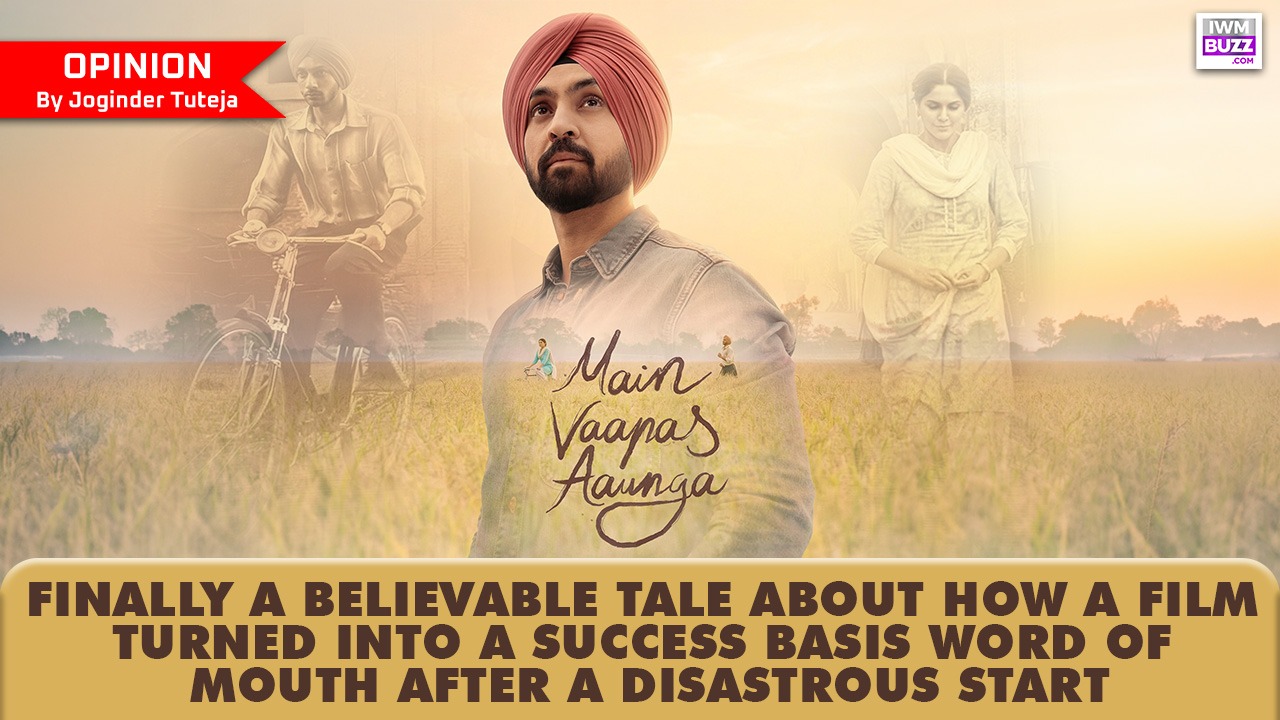
This is the reason why the turnaround of Main Vaapas Aaunga is the real case of audiences actually embracing the film by their own and giving it all the love, and that too from second week onwards. The first day, weekend and week were actually disastrous. There was awareness but interest was missing. Not many were even talking about it. However a smart marketing campaign after the first weekend focusing on Imtiaz Ali’s films finding cult status 10 years down the line drew resonance with the audience. Suddenly there was chatter all around the digital social media campaign created further awareness. Results were there to be seen in the second weekend which has turned out to be bigger than the entire first week.
The film can now go anywhere and this is practically the first Bollywood film that I can actually remember which has moved from being a commercial disaster to now a success in the making ‘after the second weekend’.
Now that’s one story that’s waiting to be told to generations to come, and something that would be believable as well!
